

Best Ultrasonic Bubble Sensors for Accurate Air Bubble Detection
2026-09-18
Air bubbles in fluid lines are silent troublemakers. They skew dosing accuracy, trigger false alarms, and wear down sensitive equipment. Ultrasonic bubble sensors offer a non-invasive, real-time way to catch these air pockets before they cause problems. Yet not all sensors are equal when it comes to precise, repeatable detection. This guide cuts through the noise, examining what separates the best ultrasonic bubble sensors for accurate air bubble detection—and why Siansonic has become a name worth watching in this space.
The Physics Behind Ultrasonic Bubble Detection That Most Guides Skip
Most write-ups stop at “the sensor sends sound waves and listens for echoes,” but that glosses over why bubbles show up at all. The key is acoustic impedance mismatch. A liquid like water has a predictable impedance, and so does the pipe wall or tissue. When a sound wave hits a gas pocket, the impedance drops by orders of magnitude, so almost all of the energy reflects straight back instead of passing through. That reflection is what the transducer picks up as a strong, early return. Without this sharp boundary, a bubble would be acoustically invisible.
The other half that often gets skipped is resonant behavior. Bubbles are not passive reflectors; they act like tiny springs. The gas inside compresses and expands under the alternating pressure of the ultrasound wave, and at a certain frequency the bubble rings like a bell. That resonant frequency depends mainly on bubble size—smaller bubbles resonate at higher frequencies, larger ones at lower frequencies. A practical detector often sweeps frequency or uses a broadband pulse to get multiple bubbles ringing at once, which is why a single fixed-frequency probe can miss smaller or larger pockets that aren't near its sweet spot.
Then there's the Doppler shift, which most guides either ignore or explain backwards. A stationary bubble reflects at the same frequency it receives, but a bubble moving with the fluid shifts the returned frequency slightly. By measuring that shift, the system can tell not just that a bubble is present, but whether it is moving toward or away from the transducer. Combined with the reflection amplitude and the resonant signature, this lets a well-tuned detector separate actual free gas from harmless echoes caused by density layers or wall roughness. The physics is not magic; it is just impedance, resonance, and motion, all folded into one signal.
Clamp-On vs. In-Line: Which Sensor Architecture Fits Your Setup?
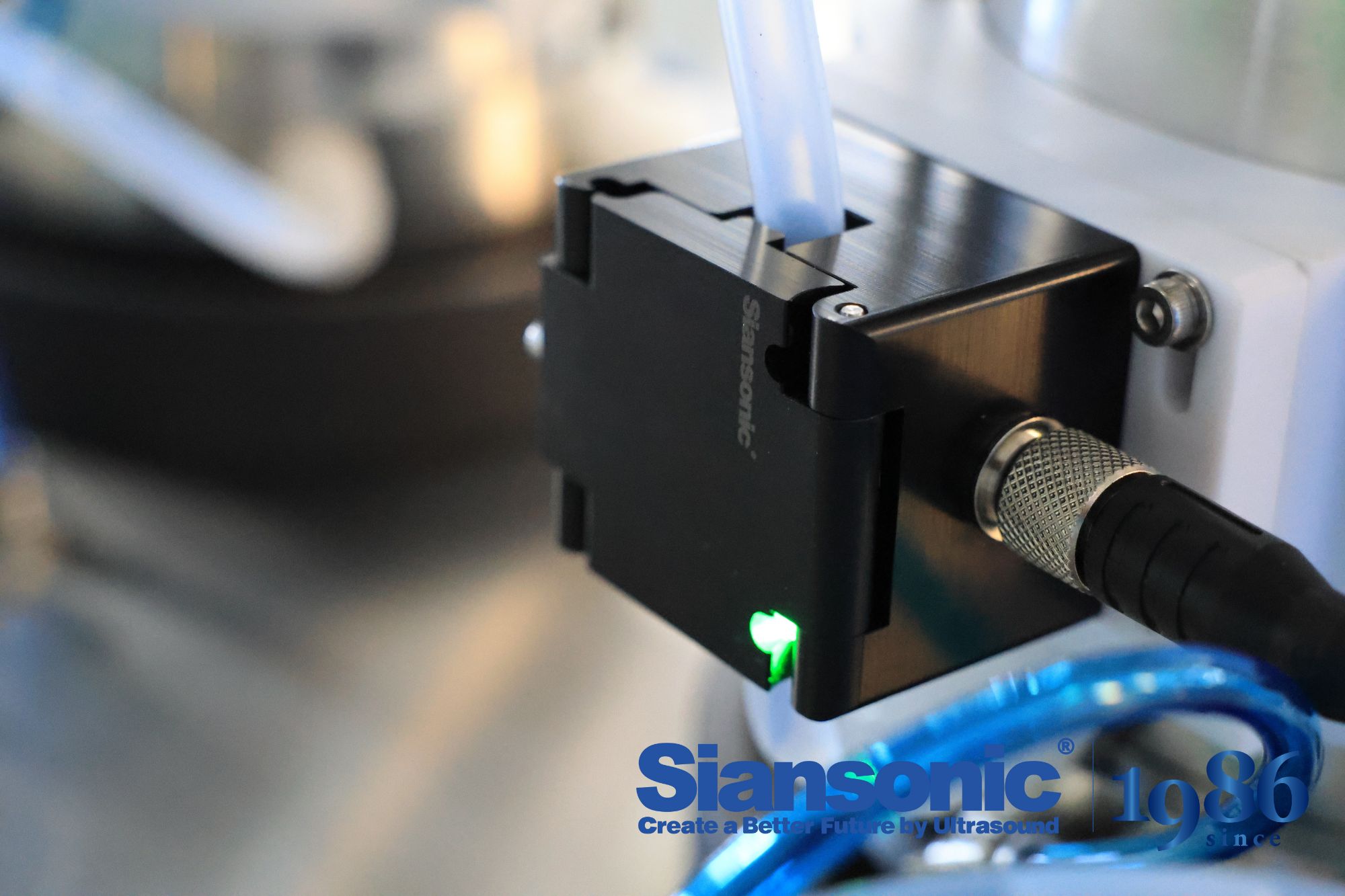
Choosing between clamp-on and in-line sensors often comes down to how much disruption your process can tolerate. Clamp-on designs sit outside the pipe, measuring through the wall without ever touching the fluid. That means zero risk of contamination and no need to shut down for installation—ideal for sanitary lines or retrofit jobs. In-line sensors, by contrast, are inserted directly into the flow path, giving you a more intimate reading of temperature, pressure, or chemical composition. The trade-off is that you have to cut the pipe, install fittings, and potentially drain the system just to get them in place.
The real decision hinges on accuracy requirements and maintenance habits. If you need tight tolerances and fast response times, in-line usually wins because nothing is between the sensor and the medium. Clamp-on units can suffer from signal attenuation through thick pipe walls, air gaps, or coatings, so they demand careful surface preparation and calibration. But for non-critical monitoring or temporary setups, that convenience factor is hard to beat. Many plants use a hybrid approach: clamp-on sensors for trending and diagnostics, then switch to in-line only where precision really matters.
Think about your operating environment too. High-temperature or high-pressure lines often rule out clamp-on options unless the transducer is specifically rated for those conditions through metal or insulation. In-line sensors handle extreme cases more gracefully because they are part of the pipe assembly itself. On the flip side, if your fluid is highly corrosive or abrasive, keeping the sensor outside may extend its life dramatically. There is no universal right answer—just the one that matches how often you need to move, replace, or recalibrate the device without stopping production.
Why Response Time Is the Unsung Hero in High-Velocity Fluid Lines
In the world of high-velocity fluid lines, everyone obsesses over flow rate, pressure drops, and material durability. Yet the factor that quietly separates peak performers from mediocre setups is response time. It's the gap between a command signal and the actual change in fluid movement—a delay so brief it's often dismissed as negligible. But when lines are pushing fluids at extreme speeds, those milliseconds compound into overshoot, oscillation, and wasted energy. Engineers who tune for response time first often find that many other performance issues simply vanish.
Consider a hydraulic actuator in an automated press: if the proportional valve lags by even 20 milliseconds, the cylinder may close too late or too hard, causing part damage or inconsistent cycles. Fast fluid lines aren't just about raw velocity—they're about how quickly the system can correct course. A line with sluggish response might still move fluid quickly in steady state, but it fails the moment dynamic loads or sudden stops demand split-second adjustments. Optimizing response time means selecting valves with high bandwidth, minimizing line lengths where possible, and reducing trapped air or compliance that smears the pressure signal.
The payoff of treating response time as a first-class design parameter is hard to overstate. Machines run smoother, valves wear less because they're not fighting oscillations, and energy consumption dips because the system isn't constantly over- or under-shooting. In racing brake lines, injection molding, or even high-speed beverage filling, the difference between a winner and an also-ran is often not more flow—it's faster, cleaner response. So next time you're sizing a fluid line, ask not just how much it can move, but how quickly it can decide to move.
Sensitivity Settings: Tuning Out False Positives Without Missing Real Bubbles
Finding the right sensitivity level is less about picking a number and more about understanding the noise floor of your data. Too aggressive, and you'll chase shadows; too cautious, and genuine opportunities slip by. The goal is to make the detector skeptical enough to ignore random fluctuations but not so cynical that it dismisses an emerging pattern as background chatter.
A practical approach starts with a baseline of confirmed events, then adjusts the threshold until every missed signal is accounted for and every false alarm has a clear explanation. This often means pulling in contextual variables like volume, velocity, or historical volatility. Instead of a single fixed cutoff, use a sliding window that adapts to recent market or system behavior. When the sensitivity feels right, you'll notice that false positives become rare, while the real bubbles still trigger an alert early enough to act.
Material Matters: Acoustic Coupling in Silicone, PVC, and Glass
Silicone remains the workhorse for medical and underwater acoustic coupling largely because its characteristic impedance sits close to water and soft tissue. That closeness lets a single-element transducer push energy across the boundary without dramatic reflection losses. The trade-off shows up in its damping behavior: thicker silicone layers can attenuate high-frequency components, rounding off pulse edges and reducing axial resolution. Thin, controlled bond lines usually deliver the best compromise between coupling efficiency and signal fidelity.
PVC rarely gets credit for acoustic friendliness, yet it appears in countless housings, tubing, and test fixtures. Its higher stiffness and density create a sharper impedance step at water or air boundaries, so more incident energy bounces back before reaching the sensor. Plasticizer content changes the picture further by shifting the speed of sound and softening the polymer. In practice, PVC works acceptably when the wall is thin relative to wavelength and the surface is wetted with couplant, but it should not be treated as a transparent acoustic window.
Glass occupies the opposite end of the spectrum: high stiffness, high density, and an impedance so far removed from water that an untreated glass-water interface reflects most of the acoustic pulse. That is why glass lenses and windows in high-frequency imaging rely on quarter-wave matching layers or gel-filled gaps to coax energy through. The payoff is dimensional stability and a hard, clean surface that holds precise curvature or parallelism, which can matter more than raw transmission when the optical and acoustic paths must share the same window.
Field-Proven Mounting Tips from Maintenance Teams
Torque marks are the first line of defense against loose fasteners. A lot of failures come from bolts that back off slightly without anyone noticing. Maintenance crews paint a straight line across the nut, washer, and mounting surface. Any rotation shows up immediately as a broken line. Spring washers often lose tension in vibrating equipment, so many teams now combine torque marks with conical washers or a drop of thread locker instead of relying on the split washer alone.
Outdoor mounts fail more from water wicking along cables than from direct rain. Always route the cable downward before it enters the junction box, and secure the loop with a UV-resistant tie. This drip loop keeps moisture from running straight into the gland. Also, place the sealing gasket on the inside of the bolt circle. If it sits outside, it squeezes out when you tighten the bolts and loses its seal.
For sensors and small instruments, avoid bolting the body rigidly to a vibrating frame. A thin rubber pad between the sensor and the bracket cuts high-frequency shock and prevents false readings or cracked housings. Leave 10 to 15 centimeters of slack in the cable right at the sensor exit. Tension on the cable can pull the internal solder joints apart long before the outer jacket shows any damage.
FAQ
For IV lines, you want a sensor with high-frequency ultrasound (2 MHz or above) because shorter wavelengths can resolve smaller bubbles—down to about 10-20% of the tube diameter. Clamp-on non-invasive models are preferable since they don't touch the fluid. Also check for adjustable sensitivity and a response time under 10 ms if you need real-time alarms. Some sensors use pulsed Doppler while others use continuous wave; pulsed tends to reject noise better in moving tubing.
Ultrasonic sensors work through opaque tubing and most liquids, including blood or dark chemicals, where optical sensors struggle. They aren't affected by color or ambient light, and they can detect bubbles inside metal or thick-wall pipes if acoustically coupled. However, ultrasonic sensors can have trouble with highly attenuating liquids or very small tubing diameters below 1/16 inch. Optical sensors are cheaper and simpler but require transparent tubing and clean surfaces. So if your application has non-transparent lines or variable lighting, ultrasonic is the better choice.
Yes, but you need to lower the frequency because high-frequency sound attenuates quickly in viscous fluids. A 500 kHz to 1 MHz sensor is usually a good starting point for liquids above 100 cP. You also need to account for slower acoustic velocity changes—some sensors allow you to set the speed of sound manually. Mount the sensor in a straight pipe section away from pumps to reduce false positives from turbulence. Testing with the actual fluid is essential since the acoustic impedance difference between the liquid and air bubble becomes smaller in very viscous media.
A frequent issue is mounting the sensor on a curved or tapered section of tubing, which scatters the ultrasound beam. Always install it on a straight, fully filled pipe run with at least 10 diameters of straight length upstream. Applying too much or too little coupling gel also degrades signal; use a thin, even layer. Don't over-tighten clamp-on sensors because that can deform the tubing and create internal reflections. Finally, keep the sensor away from ultrasonic cleaners or other high-frequency noise sources.
A few models stand out in field use. The Sonotec SONOCHECK ABD06 is popular for medical devices because it integrates temperature compensation and handles very small tubing diameters. Introtek's BDR-050 works well in industrial solvent and reagent lines, with a robust stainless housing. For R&D or prototyping, the Moog F1 series offers adjustable frequency and analog output. But the exact model depends on your tube size, flow rate, and liquid type—always request a test sample with your actual tubing.
Start by establishing a baseline with clean, bubble-free liquid flowing at your normal rate. Record the sensor's output voltage or threshold setting. Introduce known bubble sizes using a syringe or a microbubble generator, and adjust the trigger level until the smallest critical bubble (e.g., 50 µL) triggers consistently while normal flow noise does not. Many sensors have a teach mode that learns this from a few runs. Recalibrate whenever you change tubing material, liquid temperature, or viscosity.
Yes, many pharmaceutical fill lines use clamp-on ultrasonic sensors because they are non-invasive and can be validated without contacting the product. Accuracy depends on proper acoustic coupling and stable line pressure. In fill applications, sensors often detect bubbles in the filling needle or transfer line before dispensing. Look for models with 21 CFR Part 11 compliant data logging if you need regulatory records. Regular calibration against a reference bubble detector is recommended, but overall accuracy of ±1 bubble per 1000 fill cycles is achievable with the right setup.
Conclusion
When selecting ultrasonic bubble sensors, it's tempting to focus on specs alone, but the underlying physics dictates real-world performance. A sound wave crossing a liquid meets a sharp acoustic impedance change at the gas-liquid interface, causing reflection and attenuation that sensors translate into a bubble count. The best units exploit this without becoming jumpy. Clamp-on models preserve sterility and avoid wetted parts, yet they suffer coupling losses through tubing walls; in-line sensors give cleaner signal paths but demand more invasive plumbing. In high-velocity lines, response time is what separates a useful alert from a missed event—look for sensors that sample fast enough to catch transient air slugs. Sensitivity adjustments should let you dial out micro-bubbles that don't matter while still flagging larger voids, otherwise false alarms erode trust.
Material choice is another quiet determinant. Silicone tubing transmits ultrasound reasonably well but can dampen high frequencies; PVC is stiffer and offers better acoustic coupling, while glass gives excellent transmission but is fragile and rarely used outside lab settings. Field crews recommend mounting sensors on straight runs away from pumps and valves, using a thin layer of acoustic couplant for clamp-on types, and securing cables to avoid vibration-induced noise. If you can, test with your actual process fluid and temperature, because viscosity and dissolved gas change baseline readings. The most accurate setups combine a fast-response in-line sensor with conservative threshold tuning and a mounting location verified by a quick bubble injection test. That practical balance, not raw sensitivity numbers, is what keeps air detection reliable shift after shift.
Contact Us
Contact Person: Ivy Zhang
Email: [email protected]
Tel/WhatsApp: +86 1081502288
Website: https://www.siansonic.com/