

Custom French Arm Crutch: How to Choose the Right Fit for Comfort and Stability
2026-09-12
Finding a French arm crutch that truly fits can mean the difference between effortless mobility and constant discomfort. When it comes to custom options, the details matter more than ever. In this guide, we’ll break down exactly how to choose the right fit for lasting comfort and rock-solid stability. Whether you’re dealing with a recent injury or a long-term condition, the right pair of crutches—like those from Suncare—can transform your daily routine. Let’s explore the key factors that most people overlook, so you can walk with confidence again.
Pin Down Your Measurements Before Ordering a Custom French Arm Crutch
Most off-the-shelf crutches fail because people guess instead of measure. For a custom French arm crutch, start with your regular walking shoes on, stand against a wall, and let your arm hang naturally. Measure from the floor to the prominent bone on the outside of your wrist. That gives the correct overall length, so the handle sits where your wrist bends without forcing your shoulder up.
Don't stop there. The forearm cuff is not a one-size-fits-all strap. Wrap a soft tape around your forearm at the widest point, about two finger widths below the elbow, and note both circumference and the distance from that point to your wrist crease. If the cuff is too tight, it digs in; too loose, it slides and you compensate with your upper body. Give these numbers to the maker even if the order form only asks for height.
Recheck measurements after any changes like new shoes, swelling, or weight shifts. A difference of half an inch in the handle-to-floor length can throw off your gait and put extra load on your wrist or lower back. When in doubt, have someone else read the tape while you stand relaxed—looking down at the number changes your posture just enough to skew the result.
Handle Position: The Small Detail That Prevents Hand Fatigue
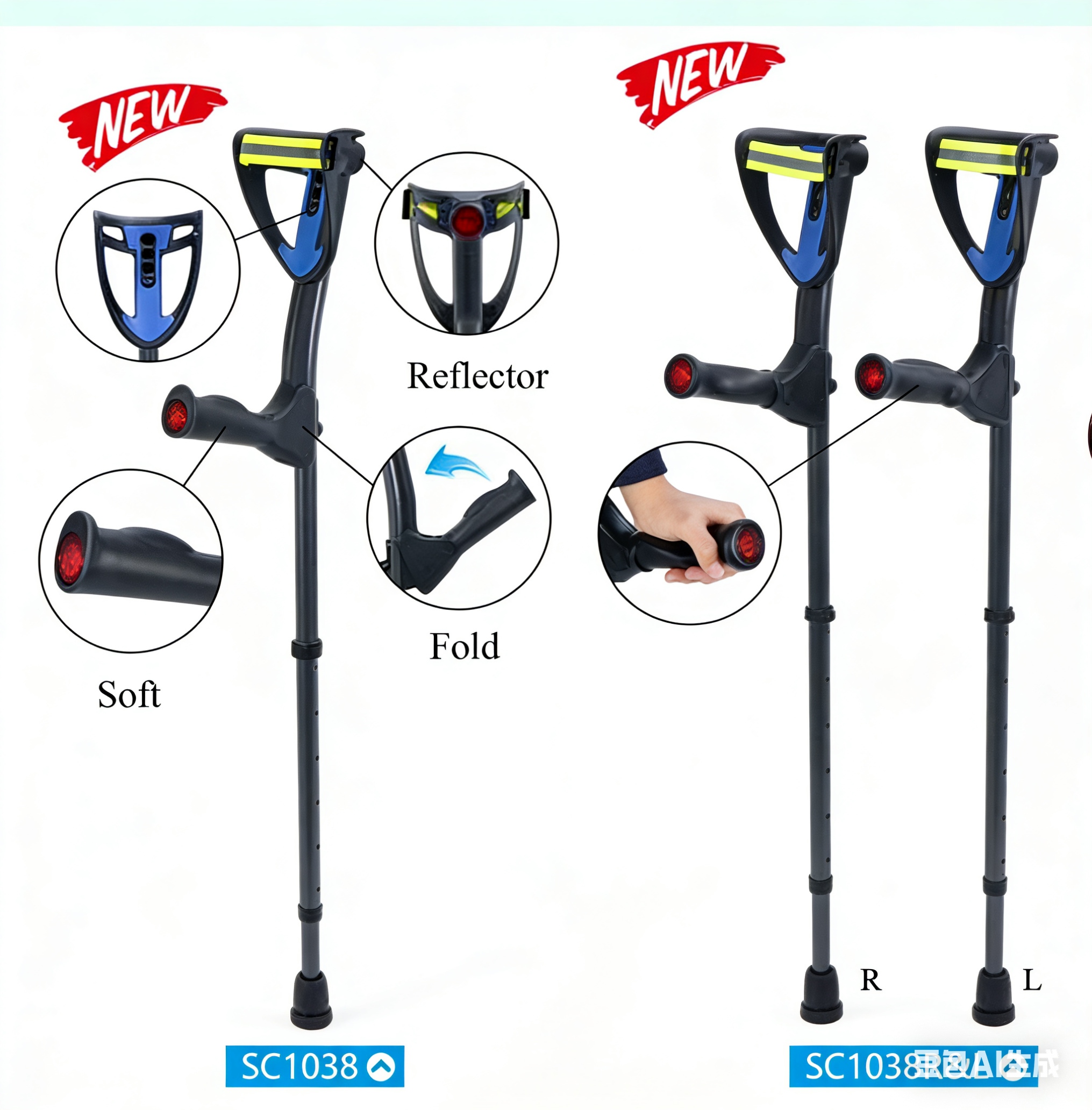
Most people never think about where their hands sit on the handle until the ache starts creeping up the forearm. A grip that's too low forces your wrist into an awkward bend, turning every small movement into a strain. Shift your hand slightly higher, so the pressure runs straight down through the bone instead of across the tendons, and suddenly the same motion feels effortless. That tiny adjustment isn't about strength—it's about letting the handle do the work of aligning your arm the way it was meant to move.
The real trick is noticing how your fingers wrap. A death grip tires you out twice as fast as a relaxed hold, because you're constantly fighting the tool's own balance. If the handle sits back toward the palm, you can let your fingers curl just enough to steer, not squeeze. On longer tasks, try shifting your hand forward or back by a centimeter or two—you'll be surprised how a different contact point changes which muscles take the load. Your wrist stays neutral, and the fatigue that used to hit after twenty minutes barely shows up at all.
It also helps to match the handle's angle to the way your arm naturally hangs. If the grip tilts away from your body, you're compensating with your shoulder and elbow without realizing it. Rotate the handle or adjust your stance so the tool feels like an extension of your forearm, not something you're holding up against gravity. Once you find that spot, your hand stops fighting, your fingers relax, and the work flows through your arm instead of pooling in the small joints that give out first.
Cuff Fit: How Snug Is Too Snug for All-Day Comfort
A cuff that leaves deep marks on your skin after a few hours is working against you, not with you. The sweet spot sits somewhere between a gentle hug and a firm handshake—secure enough to stay in place when you move, yet loose enough to forget you're wearing it. If you catch yourself tugging at the fabric or flexing your wrist to shift the pressure, that's a signal the fit has drifted into uncomfortable territory.
Think about the subtle changes your body goes through during an ordinary day. A cuff that feels fine in the morning can become restrictive by mid-afternoon as your hands warm up and blood flow increases. The real test isn't how it fits when you first put it on, but how it behaves after hours of typing, driving, or simply carrying groceries. A well-designed cuff accounts for that natural expansion, offering a bit of give without sliding down your forearm.
The material and construction play a bigger role than most people realize. A stiff, unyielding band might feel precise at first but becomes a distraction over time. Softer fabrics with a slight stretch allow the cuff to move with your body instead of fighting it. When you find the right balance, you stop noticing the cuff entirely—and that absence of awareness is exactly what all-day comfort should feel like.
Why Your Crutch Height Should Match Your Natural Arm Swing
Crutches set too high force your shoulders up into a shrug with every step, while ones set too low make you drop your weight onto your wrists instead of letting your arms swing from a relaxed shoulder. Both mistakes add strain that has little to do with the injury you are actually recovering from.
When the handgrip lines up with the crease of your wrist while your arm hangs naturally, the crutch becomes an extension of your normal swing instead of a separate chore to manage. That lets your triceps and lats do the work they are built for, keeps your elbow slightly bent, and gives you a rhythm that feels closer to walking than fighting your equipment.
The real test is simple: stand tall, let both arms hang loose, and check that the top of the crutch sits about two fingers below your armpit, not jammed into it. You should be able to move forward without lifting your shoulder or leaning to one side. If not, adjust the height before your next walk, not after the soreness sets in.
Material Choices That Balance Lightweight Feel and Reliable Support
Manufacturers often turn to reinforced nylon or carbon fiber composites when they need to shave grams without sacrificing structural integrity. These materials have a high strength-to-weight ratio, meaning a thinner wall or a smaller cross-section can still handle repeated stress. The result is gear that feels almost weightless in hand yet doesn't buckle under load.
Another approach pairs a stiff outer shell with a softer, energy-absorbing core. For instance, a polycarbonate exterior might provide impact resistance, while a TPU or EVA foam interior adds cushioning and rebound. This layered strategy distributes force across a larger area, so the user gets reliable support without the penalty of a bulky frame.
In some designs, the material itself is engineered at the microscopic level. Closed-cell foams with variable density can be firmer under the heel and softer under the forefoot, matching the body's natural pressure points. Likewise, metal alloys with a porous internal lattice maintain load-bearing capacity while cutting weight by up to forty percent compared to solid counterparts.
Try a Quick Walk Test to Confirm Stability Before You Finalize the Fit
Once you've adjusted the straps and buckles, don't rush to declare the fit perfect. Take a short walk around the room, up and down a hallway, or even on a few stairs if you have them. Pay attention to whether the item shifts, rubs, or slides with each step. A proper fit should feel secure without being restrictive, and a quick walk reveals issues that standing still never will.
During your walk, notice any pressure points or areas where the fabric bunches or pulls. If the item is meant to stay in place, it shouldn't require constant re-adjusting. Listen for any unusual sounds from buckles or straps that might indicate loosening. This simple test takes less than a minute but can save you from discomfort later, especially if you'll be wearing it for long periods.
Finally, try a few natural movements like bending over or reaching up. If everything stays put and feels comfortable, you've likely found the right fit. If not, make small adjustments and walk again. Stability in motion is often the true test of a good fit, so don't skip this step before finalizing.
FAQ
A custom crutch is built around your specific measurements—forearm length, grip height, and even the angle of the cuff—so it follows your natural posture instead of forcing you to adapt to preset holes. That usually means less wrist strain and better balance on uneven ground.
Stand with your shoes on and let your arm hang naturally. The grip should line up with the crease of your wrist, not your hip bone. Have someone mark that point on the crutch while you're standing straight, then adjust from there. A half-inch too high or low changes how much weight your shoulder carries.
The cuff should wrap around the widest part of your forearm, about two finger-widths below the elbow. Too close to the elbow and it digs into the joint when you lean; too far down and you lose the leverage that keeps the crutch stable.
If you spend long hours on the crutch, a custom grip angle is worth it. Many people find a slight inward tilt reduces pressure on the thumb side of the wrist. It's not overkill—it's the difference between finishing the day with a tired arm and finishing with a painful one.
Look for a cuff with a breathable, padded liner—something like EVA foam or a soft gel—because bare plastic gets sweaty and rubs. For the handle, cork or a dense foam gives better friction than hard rubber, especially in humid weather. Carbon fiber shafts are lighter, but aluminum is still fine if the fit is dialed in.
Yes, and that's one of the best reasons to go custom. The height and cuff rotation can be set independently for each side, so you don't end up leaning sideways to compensate. A good fitter will watch you walk and make micro-adjustments until your shoulders stay level.
Snug enough that the crutch doesn't fall when you let go, but loose enough to slide two fingers under the strap. If you have to fight to get your arm out, it's too tight and will restrict circulation. If the crutch swings like a pendulum when you walk, tighten it up.
Not really—that's the point of custom. You might feel the new grip shape for a day or two, but if you're getting blisters or shoulder pain after a week, the fit is off. Go back to your fitter and have them re-check the height and cuff angle before you muscle through it.
Conclusion
Finding a custom French arm crutch that truly fits means looking beyond a simple height chart. Start with exact measurements of your forearm length, wrist-to-floor distance, and the width of your arm where the cuff will rest. These numbers set the foundation, but the real comfort comes from fine-tuning two contact points. The handle should sit at a height where your elbow bends slightly—roughly 15 to 20 degrees—so your wrist stays straight and you avoid squeezing. If the grip forces your hand upward or downward, fatigue sets in quickly, even on short walks. The cuff, meanwhile, needs to wrap around your forearm without pinching. You should be able to slide one finger between the cuff and your skin when it is secured; any tighter and you risk pressure sores, any looser and the crutch will wobble with each step.
Height adjustment is equally personal: when you stand relaxed with the crutch at your side, the handle should align with the crease of your wrist, not your hip or thigh. This mirrors your natural arm swing and keeps your shoulder from hiking up. Material choice then balances weight and durability—carbon fiber feels nearly weightless but costs more, while aluminum offers solid support at a lower price. Before finalizing, do a quick walk test on a flat surface and then a few steps on uneven ground. The crutch should feel like an extension of your arm, with no clunking at the cuff or slipping at the tip. If you notice any hesitation in your stride or extra effort in your wrist, adjust the cuff angle or handle rotation by a few millimeters. Small tweaks, not a complete redesign, usually solve the problem.
Contact Us
Contact Person: Frank Chan
Email: [email protected]
Tel/WhatsApp: 0086-13924529088
Website: https://www.suncare-medical.com