

OEM Plastic Push Pull Connectors: Key Benefits and Selection Tips
2026-11-18
Plastic push pull connectors rarely get much attention until a failed connection brings a device to a halt. If you are sourcing OEM connectors that need to survive frequent mating cycles, tight spaces, and harsh handling, metal-shell options are not always the best answer. This guide breaks down the real advantages of plastic push pull designs and the selection details that matter most in production. At REUNION, we have seen how the right connector choice can prevent field failures before they reach your customers.
When Metal Is Overkill for Plastic Push-Pull Connectors
The appeal of metal connectors is easy to understand—they feel solid, look professional, and suggest durability. But many plastic push-pull designs now handle the same daily wear without the extra weight or cost. In tight device layouts or handheld equipment, metal bodies can actually work against you, adding bulk where every gram matters. Once you strip away the assumption that heavier means tougher, plastic starts to look less like a compromise and more like a deliberate engineering choice.
Corrosion resistance is another area where metal's reputation outruns reality. Stainless steel or nickel-plated brass may resist rust for years, but plastic connectors simply don't corrode, period. They shrug off salt spray, cleaning agents, and constant humidity without pitting or discoloration. For medical carts, food processing tools, or outdoor enclosures exposed to wet conditions, a well-molded plastic connector often outlasts its metal equivalent—no special coatings required.
Then there's the electrical isolation. Metal shells need careful grounding and insulation to avoid shorts, especially in cramped assemblies. Plastic push-pull connectors eliminate that risk entirely. They can sit directly next to sensitive traces, batteries, or other connectors without adding shielding complexity. If your design already struggles with space and signal integrity, switching to plastic isn't a downgrade—it's a way to remove a whole category of failure points.
Material Choices Most Buyers Overlook Until a Field Failure Happens
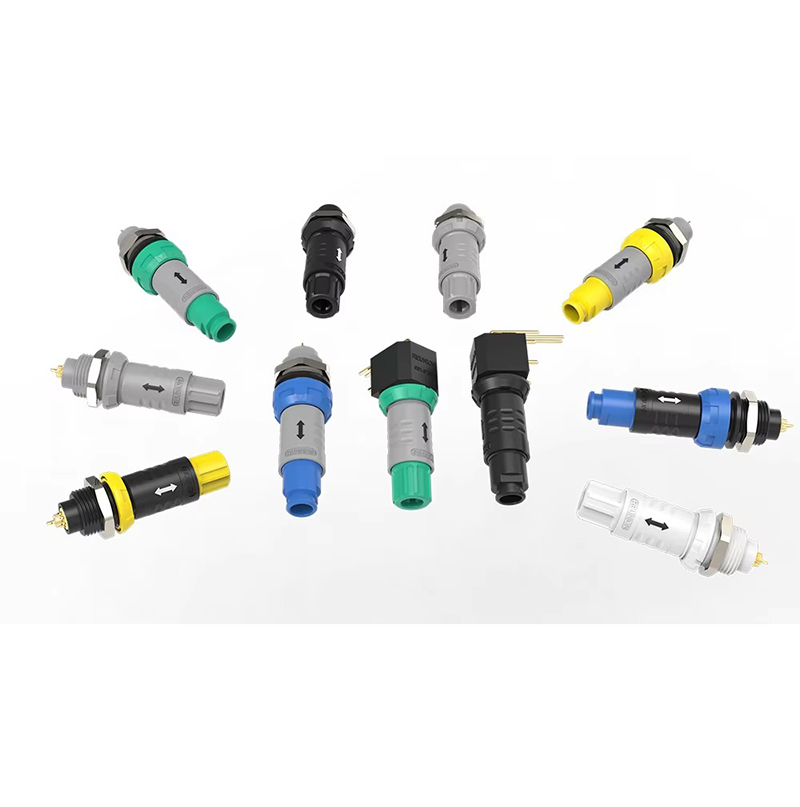
Most buyers look at tensile strength, hardness, or temperature rating and assume the material will hold up in the real application. The trouble is that those datasheet numbers rarely describe what happens after months of small temperature swings, cleaning chemical exposure, or constant vibration. A part can pass a short bench test and still crack, swell, or lose torque weeks after installation. By the time the failure shows up in the field, the cost of downtime and replacement labor far exceeds the savings from the original material choice.
Chemical compatibility with greases, detergents, and even adhesives is one of the most common blind spots. Polycarbonate, for instance, can develop micro-cracks around threaded inserts when a maintenance team switches to a harsher degreaser. Acetal may machine easily and hold tight tolerances, but it degrades quickly under prolonged sunlight unless additives are specified. These are not design-stage failures because the conditions often change after the equipment leaves the factory.
Another overlooked area is the interface between different materials, especially in damp or outdoor environments. A stainless steel fastener in an aluminum housing can create galvanic corrosion that eats away the threads even when both materials pass individual corrosion tests. Sometimes the better fix is not a costly upgrade to a superalloy but a polymer washer, a different plating, or a small change in assembly sequence. Datasheets alone miss these interactions because they evaluate one material at a time, not the assembled system.
Sealing and Strain Relief Where Low-Cost Connectors Usually Fall Short
Most budget connectors depend on a thin, snap-fit housing and a single O-ring that looks acceptable on paper but loses compression after only a handful of thermal cycles. Once the mating gap opens slightly, moisture wicks along the cable jacket and works past the rear grommet. The failure is rarely immediate; corrosion often starts at the contact crimp months later, which makes field failures difficult to trace back to the connector itself.
Strain relief is where the cost cutting becomes most visible. Instead of a tapered boot or integrated overmold that spreads bending force across a length of cable, inexpensive designs rely on a short plastic collar or a gland that grips at a single point. Every movement concentrates stress at that pivot, so stranded conductors begin to break just behind the solder cup or crimp. In high-vibration equipment, this turns a connector that passes a bench test into an intermittent fault after installation.
A practical fix usually means adding a secondary seal, potting the rear cavity, or selecting a connector with a longer flexible boot that follows the cable instead of fighting it. In wet and washdown environments, that distinction is not cosmetic; it often decides whether the connection survives the first year or becomes a recurring service item.
How to Match Latching Force to Cable Size Without Damaging the Housing
A practical way to get this right is to work from the cable jacket’s compression behavior instead of relying only on the connector’s rated pull force. Press the latch into place with your thumb and watch the housing sides. If the plastic begins to whiten or you hear a slight creak, the force is already spreading into the shell rather than staying on the contact. Swap in graduated test rods or scrap cable sections until the latch just fully seats without flexing the housing wall. The final fit should hold the cable steady under normal bending and vibration while leaving no visible stress marks on the body.
Cable diameter tolerance tends to be the hidden variable. Two suppliers can list the same gauge, yet the outer jacket may differ by a tenth of a millimeter or more, which is often enough to shift the retention force from firm to damaging. For flat or twisted cables, avoid converting by cross-sectional area alone. Measure the effective compression width and use that as your comparison dimension. A simple axial pull test with a force gauge works well here, increasing the load in small steps until the cable moves about a millimeter; that gives a more useful number than any catalog value.
When the latch feels too aggressive, resist the urge to shave the pawl or hinge immediately. A thinner jacket wall or a slightly softer insulation compound can lower the engagement force without changing the connector geometry. Keep temperature in mind as well, since nylon housings tend to soften when warm and stiffen in the cold. Matching at room temperature only can hide problems that appear on a hot production line or in a cold vehicle. Recording insertion and retention values at a few different temperatures usually reveals a safe working window for each cable family.
Molding Tolerances and Why They Decide Your Assembly Yield
Molding tolerances are less about whether a single part measures in spec and more about how several small deviations stack up once the parts meet on the line. A snap fit that works beautifully on a prototype can fail in production because the hook is 0.05 mm short, the mating wall is 0.04 mm proud, and the hole spacing has drifted another 0.06 mm. None of these numbers breaks the individual drawing tolerance, yet together they erase the clearance needed for assembly. That accumulated error is what quietly pulls yield down even when every batch passes incoming inspection.
The trouble is that plastic does not hold still long enough for a fixed tolerance to mean much. Fillers, cooling rates, moisture uptake, and even tool wear shift dimensions across a run, so the part you measure at 8 a.m. may not be the same part you measure after lunch. When those moving dimensions land in features that locate, latch, or seal—bosses, pins, snap arms—the assembly process becomes a repeating lottery. Yield stays high only if the design leaves room for that movement, not just for the nominal dimension.
A more practical approach is to stop chasing tighter tolerances everywhere and instead protect the handful of interface dimensions that actually decide whether parts go together. Teams that map the assembly dimension chain, set realistic process capability targets for those few features, and adjust gate location or packing pressure to control warpage tend to see yield stabilize. The parts do not need to be perfect; they just need to be consistently compatible. That distinction is what separates a design that survives tooling variation from one that falls apart in production.
Questions to Ask a Supplier Before You Commit to a Custom Run
Before you sign off on a custom manufacturing run, dig into the supplier's actual production history. Ask for a list of previous clients whose orders resemble yours in material, complexity, or volume. Then follow up with one or two of those references directly. Listen for hesitations, not just praise. A factory can sound great in a sales meeting and still struggle with tight tolerances, color consistency, or delivery windows when the lights are on.
Next, get specific about quality control. Who checks the parts, at what stage, and with what tools? A vague answer like "we do full inspection" means little. Request the rejection rate for the last three similar runs, and ask how they handle defects found mid-production or after shipping. If they can't show you a clear corrective action process, assume you'll be the one managing their mistakes from a different time zone.
Finally, test their communication style before money moves. Send a detailed question about packaging, tolerances, or lead time and see how long they take to respond, whether they answer every point, and if they ask clarifying questions in return. A supplier who is slow or vague during the sales phase will not suddenly become responsive once your deposit clears. Commit only when their written answers match the confidence they show on a call.
FAQ
Plastic bodies cut a lot of weight and handle repeated sterilization or chemical exposure without corroding. They also tend to reduce part cost and give designers more freedom with color coding and overmolding.
PPSU and PEEK are the usual go-to options because they tolerate autoclave cycles and aggressive cleaning agents. Nylon blends can work for less demanding applications but may absorb moisture and shift dimensions slightly.
Ask for cycle testing data under your real operating conditions, not just a datasheet number. Pay attention to wear on the latch mechanism and contact plating, since plastic housings don't hide fatigue the way metal shells sometimes do.
IP64 may be enough for light washdowns, but aim for IP66 or IP67 if the connector might get sprayed or briefly submerged. Confirm whether the rating applies to the mated pair only or also to an unmated connector with a protective cap.
They help a lot on the production line if the supplier can hold tight tolerances on insert orientation and shell color. Still, you should include a simple visual check or poke-yoke fixture rather than relying on color alone, since lighting and material batches can vary.
Check how the latch behaves when users pull at an angle or yank the cable. A good mechanism should give clear tactile confirmation and hold firmly without needing excessive force. Ask about latch durability after thousands of cycles and whether replacement parts are available.
Custom work pays off when you need a specific shell geometry, cable exit angle, or a unique combination of signal, power, and fluid contacts. It also helps when your device branding or user ergonomics require a shape that off-the-shelf parts cannot provide.
Look for flash or sharp edges around the molded shell, inconsistent coloring between batches, loose insert alignment, and resistance during mating that changes from sample to sample. Those small defects often point to process control problems that will show up later in the field.
Conclusion
Plastic push-pull connectors earn their place in OEM builds not because they are cheaper imitations of metal shells, but because many designs simply do not need the weight, corrosion headaches, or overbuilt rigidity that metal brings. The real advantage shows up in handheld medical tools, sensor housings, and compact industrial devices where a lighter connector reduces strain on the PCB and simplifies cable management. What often gets ignored until a field failure occurs is the resin itself. A connector molded from standard ABS may look fine on the bench and then crack after repeated autoclave cycles or exposure to cleaning agents. Buyers who switch to a reinforced polyamide or PBT with the right glass loading tend to see fewer housing fractures and much better thread retention. At the same time, sealing and strain relief are where budget connectors quietly fall apart. An IP rating printed on a datasheet means little if the boot does not grip the cable jacket, or if the panel gasket compresses unevenly. In low-cost plastic parts, overmolded strain relief is often the first area to tear, so it pays to check how the boot is bonded to the housing rather than assuming the connector is sealed because it has an O-ring.
Latching force is another detail that gets oversimplified. A heavy latch on a thin cable will tug on the terminations every time the operator moves the device, while a weak latch on a thick, stiff cable will disconnect too easily. Matching the latch mechanism to the cable diameter and jacket hardness prevents cracked housings around the latch window, which is a common failure in field returns. Molding tolerances have just as much influence on assembly yield. Slight flash around the latch or bore misalignment can force the line operator to push harder, damage the pin carrier, or reject whole batches. Before committing to a custom run, ask the supplier which resins they actually stock, whether they mold the boot in-house, and how they verify latch pull force across multiple cavities. Ask for sample parts from production tooling, not prototype prints, and check for flash, gate marks, and color consistency under the same lighting used on your floor. Those small questions reveal more about long-term consistency than a polished first-article report.
Contact Us
Contact Person: Hayley Liang
Email: [email protected]
Tel/WhatsApp: +86 13480625451
Website: https://www.reunion-china.com/