

Sintered Silicon Carbide Manufacturer Explains How to Select the Right Grade for Your Application
2026-11-02
Choosing the right sintered silicon carbide grade can feel like navigating a maze—too soft, and wear accelerates; too hard, and thermal shock resistance may suffer. But it doesn't have to be guesswork. In this article, HUAYI TECH, a leading sintered silicon carbide manufacturer, breaks down the key factors that separate a good match from a costly mistake, so you can make a confident decision for your specific application.
Why Sintered Silicon Carbide Grades Rarely Interchange Between Applications
Sintered silicon carbide (SSiC) is often treated as a single material, but its grades differ far more than a simple datasheet comparison suggests. The raw powder characteristics, sintering aids, and post-sintering treatments create distinct microstructures that directly control wear resistance, thermal shock behavior, and electrical conductivity. A grade optimized for mechanical seals, where a fine grain and low porosity prevent leakage, may perform poorly as a kiln furniture beam because its dense, brittle structure cracks under rapid thermal cycling. Conversely, a coarse-grained, porous grade that withstands high-temperature furnace environments would quickly erode in a slurry pump impeller. These are not minor performance differences; they are fundamental mismatches driven by how each grade is formulated.
The misunderstanding usually starts with a shared chemical identity. Both a seal ring and a burner nozzle may be more than 95% silicon carbide, yet the remaining few percent—binders like boron and carbon, or secondary phases like free silicon—reshape the entire failure mode. A pressureless sintered grade with extremely low porosity resists abrasive wear but has poor electrical discharge machinability. A reaction-bonded grade, though technically not fully sintered, gets grouped into the same conversation and behaves entirely differently under impact. Engineers who swap one for another based on a generic “silicon carbide” label often discover the replacement fails in weeks, not because the material is inferior, but because it was never meant for that operating window.
Performance validation further complicates interchangeability. A grade proven in a rotary shaft seal under clean water cannot be assumed suitable for a chemical pump handling hot sulfuric acid, even if both are “corrosion-resistant.” The specific corrosion mechanism—grain boundary attack versus matrix dissolution—determines whether a grade survives. Similarly, a semiconductor wafer handling component may require ultra-high purity and a specific electrical resistivity range, while a sandblasting nozzle demands maximum hardness and toughness. Treating sintered silicon carbide grades as interchangeable is like assuming all stainless steels work for any mildly corrosive environment; the label hides the engineering reality.
The Mechanical Properties That Actually Matter for Your Wear Environment
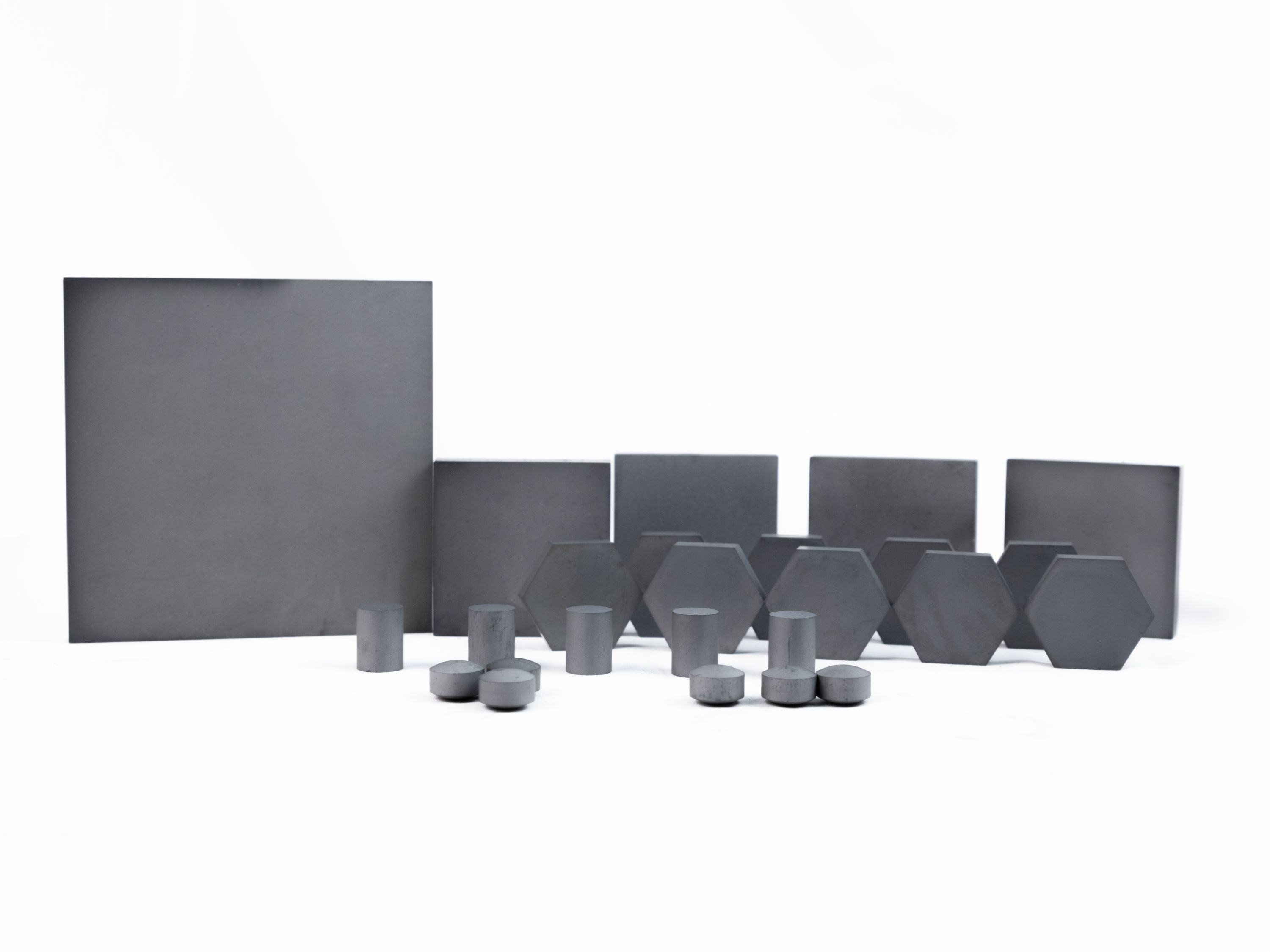
Selecting materials for wear applications often starts with a data sheet full of impressive numbers, but hardness alone rarely tells the whole story. In real operating conditions, the interaction between mating surfaces, the presence of abrasive particles, and the type of motion combine to define which mechanical property dominates your failure mode. For sliding contact under moderate loads, yield strength and work-hardening capacity frequently outweigh raw hardness, because they control how the surface deforms before micro-cracking or galling begins. In high-impact or erosive environments, fracture toughness becomes the critical parameter, since brittle materials that score well on scratch tests can shatter when struck by fast-moving debris.
Another property that quietly governs wear life is elastic modulus, especially when components experience cyclic loading or fretting. A lower modulus allows a surface to flex and redistribute contact stress, reducing the peak pressures that initiate fatigue spalling. Conversely, in abrasive wear where hard particles plough through the surface, the ratio of material hardness to particle hardness is more useful than hardness alone—if the abrasive is only slightly harder than the surface, minor increases in hardenability can shift the wear mechanism from cutting to ploughing and dramatically extend service intervals.
Ultimately, the mechanical property that matters most is the one that aligns with the dominant wear mechanism in your specific environment. Rather than chasing a single metric, map the loading conditions, particle size and shape, lubrication state, and temperature range before selecting a material. A component that survives years in a dry, low-stress sliding application might fail within hours in a slurry with sharp, high-velocity particles, even if its hardness rating looks superior on paper.
How Impurity Levels and Density Shift Performance in Corrosive Media
When a metal sits in an aggressive environment, the first thing that usually gets overlooked is how the tiniest impurities quietly change the rules. A few parts per million of sulfur or phosphorus can turn a passive oxide layer into a patchwork of weak spots, letting chloride ions slip through where they never could before. It’s not dramatic at first—just a faint discoloration, maybe a slight drop in open-circuit potential. But over weeks, that uneven surface becomes a map of micro-galvanic cells, each one nibbling away at the base material. The result is often pitting that starts shallower but spreads wider, because the impurity-rich zones act like pre-drilled pathways for corrosion.
Density plays a quieter but equally stubborn role. Higher density usually means fewer voids and tighter grain packing, which sounds good until you realize stress concentrates differently. In a dense, impurity-laced alloy, local hardening around inclusions creates tiny stress risers. Under cyclic exposure to corrosive media, those risers become initiation points for stress-corrosion cracking. A slightly lower density material with uniform impurity distribution might actually outperform a denser one with clustered defects. It’s not about being heavy or light; it’s about whether the mass is locked into place or carrying hidden internal strain.
Operators often fixate on bulk composition and forget that the surface is where density and impurities meet first. Polishing away the top few microns can remove a leached layer rich in impurity oxides, temporarily restoring performance. But if the underlying material has density gradients from casting or welding, the benefit doesn’t last. The corrosive media finds the path of least resistance—often along density boundaries where impurity segregation is highest. That’s why two pipes with identical certificates can corrode at wildly different rates in the same acid stream.
Grain Size Isn't Just a Spec: What It Means for Surface Finish and Friction
Grain size often gets reduced to a line on a material data sheet, but its influence on surface finish runs deeper than most machining guides suggest. When grains are small, the surface left after grinding or polishing tends to be smoother because there are more grain boundaries acting as natural stops for deformation. That doesn't mean fine-grained metals always win—very small grains can make the material more prone to tearing during aggressive cutting, leaving behind micro-roughness that spec sheets won't capture.
Friction is where the real surprises show up. A fine-grained surface might look polished, but under load the high density of boundaries can raise hardness and reduce ductility, which changes how asperities deform when two surfaces slide. In some alloys, coarser grains allow a thin layer of material to smear and create a quasi-lubricating film, actually lowering friction compared to a harder, finer-grained counterpart. So the same grain size that improves one surface property can quietly degrade another.
The practical takeaway is to stop treating grain size as a checkbox. If you're chasing a low-friction interface, you need to think about how the grain structure interacts with your specific finishing process—polishing, honing, or coating. A slightly coarser grain with the right post-processing might outperform an ultra-fine grain that was optimized for hardness alone. The spec tells you the average size; it doesn't tell you what the surface will actually feel like or how it will slide.
When a Premium Grade Pays for Itself in Downtime Avoidance
The real question is rarely whether a premium grade costs more upfront, but what a single hour of unplanned downtime does to your bottom line. In operations where a conveyor stoppage or a bearing seizure halts an entire line, the arithmetic flips quickly. A lubricant that resists thermal breakdown for twice as long, or a power supply rated for harsh transients, might add three percent to your parts budget. That same part failing during peak throughput can erase a week's margin before anyone reaches the bypass switch.
Break-even math isn't speculative once you track mean time between failures honestly. If the standard component has a documented failure rate of once every 18 months under your load profile, and each incident costs six hours of labor plus scrapped material, you're not paying extra for the premium grade—you're prepaying a fraction of the next outage. The trick is recognizing which environments push the standard grade past its comfort zone: continuous vibration, temperature swings, or contaminated air. In those conditions, the premium option isn't an upgrade; it's the minimum viable specification.
There's also a quieter advantage that rarely shows up on a purchase order: the avoidance of cascading failures. A seized gearbox doesn't just ruin its own housing; it can twist a drive shaft or overload an adjacent motor. Premium grades earn their keep by widening the gap between the first warning sign and catastrophic failure, giving your maintenance team a real window to intervene. When that window means the difference between a scheduled swap on a Tuesday morning and a frantic repair at 2 a.m., the premium cost becomes irrelevant.
Questions Worth Asking Your Supplier Before Locking In a Grade
Before you commit to a grade, dig into the supplier's sourcing story. Ask where the material actually comes from, how long they've worked with that specific mill or producer, and whether the grade has shifted over the last few seasons. A supplier who hesitates or gives you a rehearsed response is telling you something real about consistency you can't see on a spec sheet.
Next, press on the practical limits of the grade in your application. What happens when your process runs a little hotter, faster, or with more recycled content mixed in? Ask for real examples of customers who pushed the grade past its standard window, and what broke first. The answers will tell you whether the grade has headroom or if it's already at the edge of its performance envelope.
Finally, ask about the supplier's own incoming inspection and lot-to-lot control. How do they decide a batch meets the grade? What do they do when it doesn't? If they can't walk you through their rejection criteria and a recent corrective action, you're not buying a grade—you're buying a hope.
FAQ
Start with the operating environment: temperature swings, chemical exposure, and abrasive media. Then match those conditions to material properties like thermal conductivity, corrosion resistance, and hardness. A grade that excels in a dry running seal may fail quickly in a highly acidic slurry if its sintering aids leach out.
Additives like boron and carbon are common in direct sintered grades, but they affect grain boundary chemistry. For semiconductor or high purity applications you often need a grade with minimal metallic impurities, which pushes you toward a finer, more controlled additive package. In less demanding wear parts, a standard additive system keeps cost down without sacrificing core strength.
Finer grains generally deliver higher hardness and better wear resistance, which is useful for precision seals and nozzles. Coarser grains can improve fracture toughness and thermal shock resistance. The right choice is rarely about 'finer is better' but about balancing wear life against the risk of micro-cracking under rapid temperature changes.
Direct sintered grades usually offer higher density, better corrosion resistance, and superior high temperature strength because there is no residual free silicon. Reaction bonded grades are easier to produce in complex near-net shapes and often cheaper, but the free silicon phase melts around 1400°C and can corrode in strong alkalis, limiting their use in certain chemical pumps.
Often yes, but you need to verify the grade's purity and sintering additives. A dense alpha sintered SiC with low metallic content can operate above 1600°C in oxidizing atmospheres and resist most acids. However, if the environment includes hydrofluoric acid or molten strong bases, even the best sintered grade will struggle, and you may need a coating or alternate material.
Porosity is a direct leak path and a stress concentrator. Seal faces demand grades with near zero open porosity, often achieved through pressure assisted sintering or hot pressing. Even a small increase in porosity from 0.5% to 2% can drop the seal's reliability under high pressure, so manufacturers typically specify the maximum acceptable porosity for such components.
For bearings, focus on elastic modulus, hardness, and fracture toughness together. High elastic modulus gives dimensional stability under load, high hardness resists abrasive wear from particles, and adequate fracture toughness prevents catastrophic cracking during edge loading or misalignment. A grade optimized only for hardness may be too brittle for shock loads.
Overlooking the mating material interaction. Silicon carbide is extremely hard, so if the counterface is too soft you will get severe adhesive wear on the softer part. Engineers sometimes pick the hardest grade available, then wonder why the system fails. The right answer often involves pairing a slightly tougher or self-lubricating grade with a compatible mating material.
Conclusion
Selecting a sintered silicon carbide grade often starts with an assumption that a part that worked in one pump will work in another. That assumption fails quickly because the material’s formulation is tuned to a specific wear couple, fluid chemistry, and operating clearance. A grade designed for dry running against carbon graphite will not necessarily survive a slurry of abrasive fines. The mechanical properties that matter are not generic hardness or flexural strength; they are fracture toughness under repeated thermal shock, elastic modulus matching with mating faces, and the ability to shed micro-cracks rather than propagate them. In corrosive media, the real performance drivers are trace impurity levels and density. Impurities like free silicon or metallic inclusions act as galvanic initiation sites, while a density shortfall of even 0.2 g/cm³ opens interconnected porosity that lets acid or caustic penetrate the matrix, triggering grain boundary attack long before measurable wear occurs.
Grain size, often listed as a simple ASTM number, quietly dictates surface finish, running friction, and the glaze that forms during break-in. A fine-grained grade may polish to a mirror and reduce startup torque, but the same microstructure may lack the thermal conductivity needed to pull heat away from a high-speed contact patch. Conversely, a coarse-grained grade tolerates larger abrasive particles but generates more friction and can score a soft mating ring. A premium grade earns its price not through marginal hardness gains but through avoiding unscheduled teardowns when a standard grade spalls or leaks after a process upset. Before locking in a grade, ask your supplier for the full impurity spectrum, not just the total purity claim; ask for density measured on the actual part geometry, not a test coupon; and ask for reference contacts in a similar service. The right answer is never a single 'best' grade—it is the grade whose failure mode you can predict and manage.
Contact Us
Contact Person: Junting Leo
Email: [email protected]
Tel/WhatsApp: +86 18615009766
Website: https://www.huayimaterial-china.com/