

Spring Energized PTFE Seal Supplier: Your Trusted Source for High-Performance Sealing Solutions
2026-11-02
When a standard seal fails under extreme pressure or aggressive chemicals, downtime becomes the real cost. Spring energized PTFE seals are built for these moments—but only if the supplier understands the material science behind them. That's where TAIFNO comes in. As a dedicated spring energized PTFE seal supplier, TAIFNO delivers high-performance sealing solutions that hold up where conventional options break down. Before you settle for another leak-prone compromise, let's explore what makes this combination of spring force and PTFE chemistry so reliable.
The Hidden Engineering Behind Long-Lasting Spring Energized Seals
The real work in a spring energized seal happens inside a groove that rarely gets seen. Instead of relying on the jacket material to maintain its own interference, a precision canted coil or helical spring sits in a carefully shaped cavity and pushes outward with a predictable load. That load is chosen not just for initial lip contact but for what happens years later, when the polymer jacket creeps, wears, or takes a set. The spring continues to apply force independently, which is why these seals keep sealing long after an all-elastomer lip would have relaxed into leakage.
Equally important is how the spring and jacket interact across a range of service conditions. The jacket compound is usually not off-the-shelf PTFE; it is filled, modified, and sometimes etched to balance friction, wear, and gas permeability. The spring itself may be stainless, Elgiloy, or a high-nickel alloy, and its wire diameter, coil angle, and installed height are matched to the groove geometry so that radial load stays within a narrow band. Too little load lets low-pressure gas slip past; too much causes heat and jacket extrusion. That balance is rarely visible from the outside, but it determines whether the seal survives thousands of thermal cycles without developing a leak path.
The final hidden element is tolerance for misalignment. Hardware bores are never perfectly round under pressure, rods shift slightly, and temperature swings change the seal cavity dimensions. A well-designed spring energized seal absorbs that motion because the spring acts as a distributed suspension, not a rigid ring. Each coil segment flexes locally, so the lip can follow minor eccentricity or surface waviness without losing contact. This combination of independent energizing force, material compatibility, and local compliance is what separates long-lasting seals from those that merely look right on a drawing.
PTFE Grades That Keep Sealing When Temperatures Swing
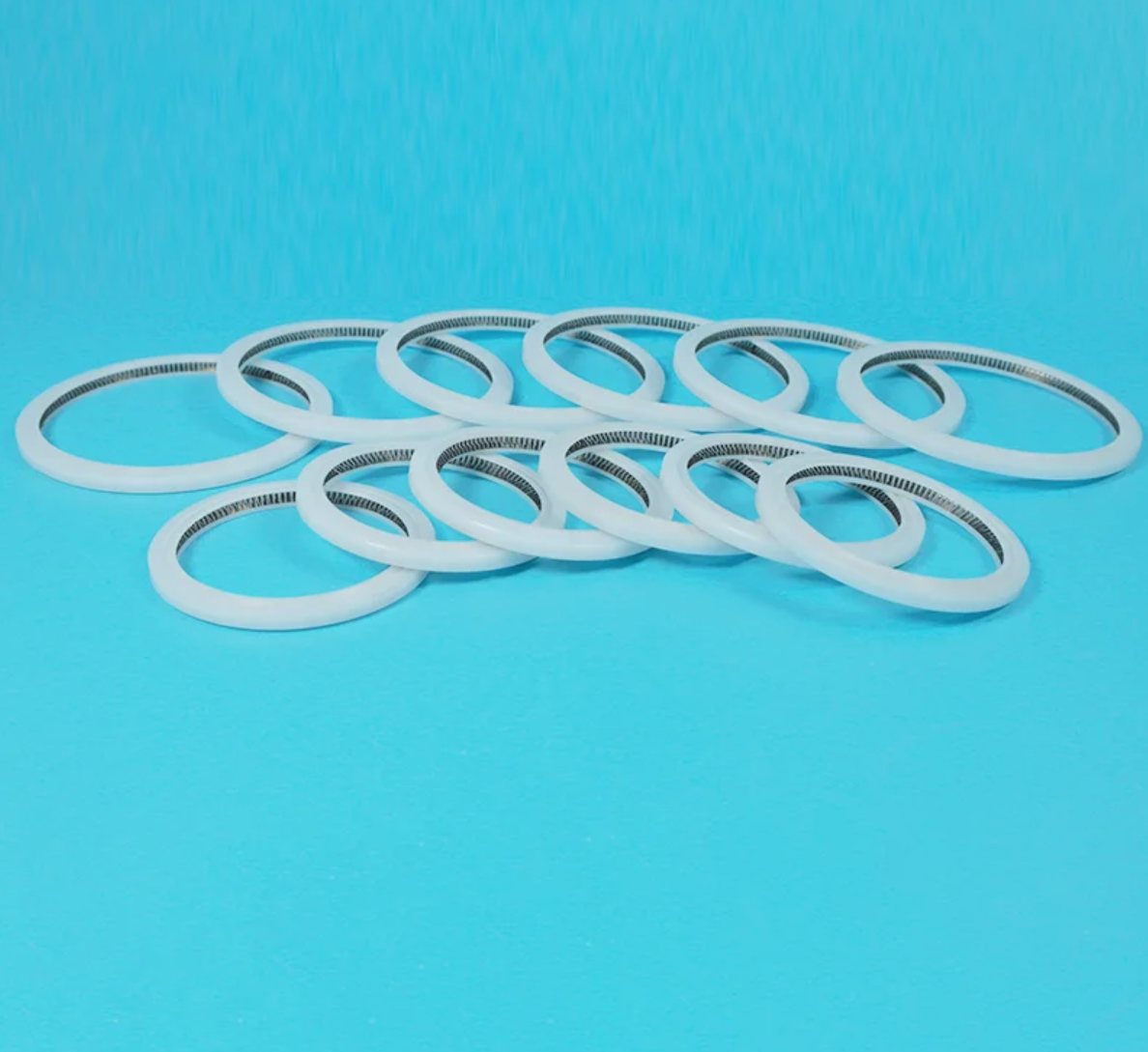
Virgin PTFE is notorious for cold flow under load, and when temperatures cycle between high and low extremes, that creep accelerates. The material expands and contracts at a rate that can loosen flange bolts, allowing a previously tight joint to open up just enough for a leak. In applications where thermal swings are frequent, a standard skived PTFE sheet often can't retain the compressive force needed to maintain a seal over time.
Filled and modified grades change that behavior. Adding glass microspheres, carbon fiber, graphite, or barium sulfate reduces the coefficient of thermal expansion and dramatically lowers creep. Some restructured PTFE grades use a network of interlocked fibrils to limit flow without sacrificing chemical resistance. The result is a material that holds its thickness under load and keeps the gasket seated even when the flange faces move with every temperature shift.
For extreme swing conditions, look for grades specifically engineered for low cold flow and high recovery. Carbon-filled PTFE performs well in steam and aggressive chemicals, while silica-reinforced versions suit cryogenic to moderate heat ranges. Expanded PTFE with a densified core offers conformability on warped flanges without losing bolt load. Pair the right grade with proper torque retention, and the seal remains tight from startup chill to full operating temperature.
Where Spring Energized PTFE Seals Earn Their Keep
Spring energized PTFE seals prove their worth in conditions that punish ordinary elastomers. Cryogenic valves, aggressive chemical dosing pumps, and high-purity semiconductor lines all lean on the PTFE jacket's near-universal chemical resistance and the spring's ability to keep a reliable lip load even after thermal cycling or pressure spikes. In LNG transfer systems, for instance, the seal must hold tight at -160°C without losing elasticity — something a standard O-ring simply cannot do.
Rotary shafts and slow reciprocating plungers present another sweet spot. The low friction of PTFE reduces stick-slip and breakaway torque, while the energizer spring compensates for wear and housing misalignment over thousands of cycles. Food and pharmaceutical equipment benefits too: the material meets clean-in-place demands, handles steam sterilization, and sheds product residue instead of swelling or hardening like rubber alternatives.
Even in less exotic settings, these seals earn their keep wherever downtime is costly. Hydraulic cylinders on offshore platforms, vacuum pumps in analytical instruments, and valve stems in chlorine service all see longer service intervals because the seal maintains a consistent contact stress without taking a compression set. It's not the cheapest option on the shelf, but in the right environment it's the one that stays out of the maintenance log.
Custom Seal Geometry Without the Guesswork
Designing a custom seal often starts with a rough sketch and a prayer that the final part won't leak. That approach costs time and money, and it rarely survives contact with real operating conditions. Instead, treat seal geometry as an engineering input, not an afterthought. Start by mapping the exact pressure profile, temperature swing, and mating surface finish. Then let those constraints drive the cross-section shape, lip angle, and compression set allowance—not the other way around.
A better method is to build a small parametric model of the seal groove and gland. Adjust the seal's free-state dimensions in small increments and simulate how the material deforms under assembly load. You'll quickly see which geometries collapse into a reliable contact band and which ones pinch, roll, or extrude. That visual feedback removes most of the guesswork before you ever cut metal.
Finally, prototype with a material close to your production compound, even if it means waiting a few extra days for a custom mold insert. The subtle differences in hardness and thermal expansion between a generic O-ring stock and your final elastomer can shift the seal's behavior enough to invalidate earlier geometry choices. Once you validate the shape under realistic conditions, you can scale the design confidently across a product family.
How We Test Every Seal Beyond Basic Requirements
Most manufacturers stop once a seal passes the minimum pressure and temperature thresholds. We don't. Our testing protocol treats those numbers as the starting line, not the finish. Every batch gets cycled through thermal shock, compression set, and chemical exposure trials that mimic years of service in weeks.
We also run real-world simulations on rotating assemblies, not just static fixtures. A seal that holds under ideal lab conditions can still weep under vibration or eccentric loading. So we deliberately introduce misalignment, debris, and abrupt pressure spikes to see where the failure points hide. If a design survives that gauntlet, we know it will handle your application without excuses.
Finally, every seal is individually inspected under magnification for micro-voids and surface flaws before it leaves the floor. We log the results by batch and keep samples for traceability. That way, "passed" means more than a checkbox—it means the seal has already endured worse than most jobs will ever throw at it.
Direct Access to Engineers Who Know Sealing Systems
When a sealing system fails on a production line, waiting through layers of sales reps wastes hours you don't have. That's why our phone lines and support tickets route straight to the engineers who actually design and test the seals. You're not explaining your problem twice to someone reading a script—you're talking to the person who can pull up your application's pressure curves and recommend a material change on the spot.
This direct line also means the feedback loop stays short. If a custom gasket isn't holding up under a new chemical wash, the engineer you speak with can walk over to the test bench, run a quick compatibility check, and send you a revised spec same day. No tiered support, no "we'll get back to you." Just a working conversation with someone who understands how elastomers behave at temperature, and who cares whether your line stays up.
FAQ
They use a corrosion-resistant spring to maintain constant lip pressure against the mating surface, compensating for wear and thermal expansion. This gives reliable sealing at low and high temperatures where standard PTFE would lose its resilience.
Chemical processing, pharmaceutical manufacturing, oil and gas, cryogenics, and semiconductor fabrication often use them because they handle aggressive media, extreme temperatures, and strict purity requirements.
Yes, depending on the spring material and jacket composition, they typically work from cryogenic temperatures below -100°F up to 600°F or more. The spring keeps the seal lip energized even when the PTFE would otherwise become too stiff or soft.
Match the spring to the chemical environment and temperature. Stainless steel works for general corrosion resistance, Elgiloy or Hastelloy for aggressive acids and chlorides, and other alloys for extreme temperature or pressure conditions. A good supplier will help you verify compatibility.
Yes, most projects require a tailored seal because standard catalog dimensions rarely fit existing hardware. You can specify inner diameter, outer diameter, groove width, lip style, and even filled PTFE compounds to meet friction or wear goals.
Lead times vary with complexity and material availability, but many suppliers can produce small prototype batches in 2–4 weeks. Larger production runs may take 6–8 weeks, depending on machining, molding, and testing requirements.
They are often installed into open grooves, so no special tools are usually needed. However, care should be taken to avoid twisting or cutting the PTFE lip. Supplied installation guides or chamfered groove edges help prevent damage.
A specialized supplier understands the interaction between spring force, lip geometry, and PTFE compound properties. They can offer design advice, material testing, and prototyping support that general distributors typically cannot match.
Conclusion
What separates a reliable spring energized PTFE seal supplier from the rest often comes down to details that never show up on a basic datasheet. The energizer geometry, jacket lip profile, and load distribution are tuned so the seal maintains consistent contact even as hardware shifts, pressure cycles, or temperatures swing from cryogenic to well past 260°C. Filled PTFE grades—glass, carbon, graphite, or polymer blends—are selected not just for chemical compatibility, but for creep resistance and low friction under specific service conditions. That kind of matching removes guesswork from custom seal geometry: instead of forcing standard cross-sections into unusual grooves, the seal is built around the actual gland, stroke, and media.
Every seal leaves with more than a certificate of conformance. Testing includes leakage under pressure cycling, friction breakaway measurement, and surface inspection beyond the usual visual checks, so the part behaves predictably in the field. Applications range from rotary unions and valve stems to syringe pumps and aerospace actuators, wherever a spring keeps the lip loaded after PTFE cold flow sets in. Direct access to engineers who know sealing systems means a supplier can suggest material substitutions, surface finish changes, or even a different spring force without a lengthy request process. That combination of applied engineering, honest testing, and responsive support is what turns a catalog vendor into an actual partner for difficult sealing problems.
Contact Us
Contact Person: Tommy Xiao
Email: [email protected]
Tel/WhatsApp: 8615651509888
Website: https://www.ptfe-factory.com