

Top Double-Unit Fixed Ball Valves Factory Delivers Reliable Performance
2026-11-02
When uptime is non-negotiable, double-unit fixed ball valves must deliver reliable performance—not just on paper, but cycle after cycle under real operating conditions. That’s the standard set by ZMV, a top factory known for precision engineering and rigorous quality control. In this post, we explore what separates their valve manufacturing from the rest and why that matters for your next project.
The Guts of a Double-Unit Fixed Ball Valve: What Actually Matters
A fixed ball valve's reputation hinges on details most people never see until something leaks. The trunnion design takes the pressure load off the seats and transfers it to the lower stem bearing, so the ball stays centered even when upstream pressure tries to shove it sideways. That means the seats do what they're supposed to do—seal—without doubling as structural supports. In a double-unit configuration, that split body lets you pull the center section without disturbing the pipe flanges, but only if the body joint is machined flat and the seal ring sits in a groove deep enough to survive thermal swings.
Then there's the seat ring material itself. Nylon and Devlon are common, but they swell slightly in wet gas and can lock the ball if the cavity pressure isn't managed. A spring-loaded seat pocket solves that by letting the seat float just enough to relieve pressure while still keeping contact. The stem area is another make-or-break point: a single O-ring is a gamble. You want at least a primary lip seal plus a secondary O-ring, with the stem collar bearing taking side load so the seal never sees bending. If those three areas—trunnion support, seat pocket, stem sealing—aren't right, the valve's rated pressure class means nothing.
From Raw Stock to Final Test: A Walk Through the Production Floor
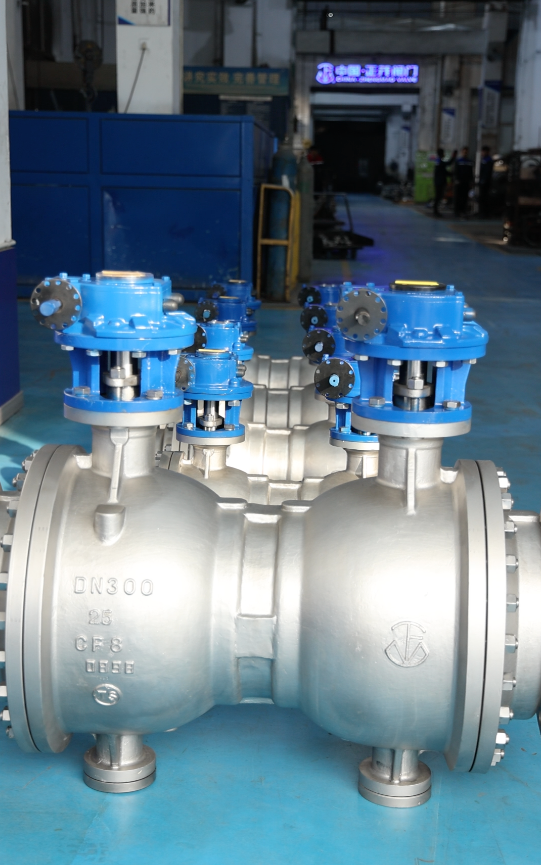
Stepping onto the floor, the first thing that hits you is the smell of cutting oil mixed with warm metal. Raw bar stock sits in angled racks near the loading dock, each piece tagged with a heat number that nobody bothers to explain until you ask. A forklift drops a bundle by the first CNC lathe, and the operator barely glances up before clamping a length into the chuck.
From there the parts move in uneven rhythm—some go straight to deburring, others take a detour through a vibratory finisher that rattles the concrete. You notice hand-written notes taped to half the machines: “check bore depth after tool change,” “new insert running hot.” It’s not the clean, choreographed flow you see in brochures. It’s more like a workshop that learned to hum through small disasters.
By the time a finished part reaches the final test bench, it has already passed a dozen quiet inspections. The tester fits it into a fixture, watches a dial settle, and stamps the traveler with a blue marker. If it fails, it goes back to the floor with a correction written in pencil. Nobody looks surprised. That’s just how the floor breathes.
Why Thick Walls and Tight Seats Aren't Optional
Thick walls and tight seats are often seen as design preferences, but in many contexts they’re the difference between safe operation and a slow, silent failure. When you skimp on wall thickness, you’re not just saving a few grams of material—you’re inviting flex, micro-cracking, and eventual fatigue under repeated load. A thin wall might hold up fine on a test bench, but out in the real world with uneven thermal expansion, vibration, and occasional impact, it starts to whisper before it shouts. A heavier section gives you room for stress to spread out instead of concentrating at the corners or around fasteners. It’s not about being old-fashioned; it’s about respecting the fact that materials aren’t perfect and neither is the environment.
Tight seats get the same kind of pushback from people who have never had to rebuild a part after a few thousand cycles. A loose seat might feel easier to assemble, but it lets the mating component rock, fret, and hammer against the contact face. That tiny movement creates wear particles, accelerates corrosion, and eventually causes leakage or loss of preload. A properly tight seat, on the other hand, distributes the load evenly and keeps the joint stiff. It forces the components to behave as one piece rather than two pieces that happen to be touching. In high-cycle applications, that’s not a convenience—it’s the only way to keep the interface from turning into a maintenance sink.
The real reason people try to get away with thinner walls and looser seats is cost and ease of manufacturing. But when you account for rework, downtime, and the reputation hit from parts that fail early, the initial savings vanish. Thick walls and tight seats give you margin. Margin for imperfect machining, margin for unexpected loads, margin for the day the operator ignores the manual. And margin is what separates a design that merely works on paper from one that keeps working long after the warranty expires.
Pressure, Temperature, and Time: Stress Testing Without Mercy
The chamber doesn't care about your launch date. It cycles from -40°C to 85°C while the pressure valve slams from sea level to 15,000 feet and back, all before lunch. We push prototypes through thirty days of thermal shock in a single week, watching solder joints crack and seals weep. That's the point: find the weak link before the customer does.
Time is the cruelest variable. A board that survives one thermal cycle might delaminate after eight hundred. So we run accelerated life tests with overlapping stressors—hot, then pressurized, then cold, then vibrated—not because the spec demands it, but because real failures cluster at intersections. Every hour in the chamber is an hour less of field returns.
Mercy isn't in the protocol. If a component survives, we raise the ramp rate. If a housing holds, we extend the dwell. The data feeds back into design revisions before a single unit ships. By the time a product leaves the lab, it has already endured more than it will ever see in the field.
When Standard Sizes Won't Do: Custom Orders Done Right
Off-the-rack dimensions work until they don't. A couch that blocks a doorway, a table too wide for the breakfast nook, shelving that leaves an awkward gap—standard sizing assumes your space is average, and few rooms actually are. Custom orders start with honest measurements and end with furniture that fits the life it's meant to serve.
We've seen clients try to force a near-miss piece into a floor plan, only to return it weeks later. Custom work flips that process. You tell us the exact width, depth, height, and materials. We handle the build, the joints, the finish. It costs more than off-the-shelf, but not as much as a second wrong purchase.
Done right, a custom order isn't just bigger or smaller—it's proportioned for how you move through a room. We keep a sample of your fabric and a record of your dimensions, so when you need a matching piece later, there's no guesswork.
Five Years On: Valves That Still Hold the Line
Five years after installation, the valves at the North Bend water treatment plant are still doing exactly what they were designed to do. No unexpected shutdowns, no costly emergency repairs, and no drop in flow control accuracy. The maintenance logs show only routine inspections and a single seal replacement on one unit—a far cry from the quarterly overhauls the previous generation demanded.
What sets these valves apart isn't a single breakthrough feature but a combination of smart material choices and a conservative operating range. The hardened trim resists cavitation damage even during low-demand periods, while the stem packing was selected to handle thermal cycling without losing torque. Operators mention that the hand feel remains consistent, with no binding or dead spots after thousands of open-close cycles.
Perhaps the most telling sign is how little attention they now receive. In a plant where equipment failures once dominated weekly meetings, these valves rarely make the agenda. That quiet reliability, born from thoughtful engineering rather than flashy innovations, is exactly what long-term infrastructure should deliver.
FAQ
The factory combines in-house precision machining with a dedicated quality control team that inspects every valve body and sealing surface. Their double-unit design reduces torque requirements while maintaining a tight shutoff, which is a differentiator in large-diameter pipeline projects.
Double-unit fixed ball valves use two independent ball and seat assemblies that work in tandem, allowing one side to maintain sealing even if the other experiences wear or debris intrusion. This design extends service intervals and provides a backup sealing path in critical isolation duties.
Each valve undergoes hydrostatic shell testing at 1.5 times the rated working pressure, followed by low-pressure air seat testing. The factory also runs a 500-cycle open-close endurance test on a sampled basis to catch any stem leakage or seat deformation that could appear after repeated operation.
The factory offers body materials in duplex stainless steel, Inconel, and titanium for aggressive media. Seats and seals are commonly available in PTFE, PEEK, or metal-to-metal configurations depending on temperature and chemical compatibility, and all wetted components are traceable to mill certificates.
They rely on CNC machining centers with automated tool compensation and a first-article inspection report for every batch. A barcode tracking system links each valve to its raw material lot, machining parameters, and test results, so any performance deviation can be traced back quickly.
Beyond standard warranty coverage, the factory stocks a full range of spare seats, stems, and O-rings for rapid dispatch. Their service engineers can perform on-site torque adjustment, seal replacement training, and valve condition assessments to help extend the lifespan of installed double-unit fixed ball valves.
Yes, the double-unit fixed ball valve line is rated up to ANSI Class 2500 and can be configured for temperatures from -196°C to 550°C. The fixed ball design reduces stem thrust and seat wear under high differential pressure, making it a preferred choice for steam, thermal oil, and high-pressure gas services.
The factory's products comply with API 6D, ISO 17292, and ASME B16.34 for design and pressure-temperature ratings. Fire-safe certification to API 607 and fugitive emission testing to ISO 15848-1 are available as standard options, along with CE marking for European pressure equipment directives.
Conclusion
A double-unit fixed ball valve lives or dies by its internal architecture. The best factories start with forged or centrifugally cast bodies, then machine the ball and seats to tolerances that prevent micro-leakage under full differential pressure. Thick walls aren't a styling choice—they resist pipe strain and thermal cycling without warping the stem bore or seat pockets. The twin-unit design splits the load between two independent sealing mechanisms, so a single blowout or seat deformation doesn't disable the whole assembly. Every component, from the anti-blowout stem to the trunnion-mounted ball, is checked against material certs and hardness maps before assembly, because a valve that fails in a sour gas line is not a warranty issue—it's a safety event.
Walk the production floor and you'll see raw bar stock tracked by heat number, CNC lathes cutting seats with less than 0.01 mm runout, and each valve serialized before pressure testing. The real proof is in the abuse: hydrostatic shells at 1.5 times rated pressure, nitrogen seat tests at low and high pressure, then thermal shock from -46°C to 200°C across multiple cycles. Standard API 6D sizes are kept in semi-finished inventory, but custom trims, extended bonnets, and non-standard end connections get the same documentation package. After five years in the field, operators report zero unplanned shutdowns from these valves—not because they were babied, but because the factory refused to cut corners on wall thickness, seat material, or final inspection.
Contact Us
Contact Person: Lucas Lin
Email: [email protected]
Tel/WhatsApp: +8613968913000 / +8613868610141
Website: https://www.zhengmaogroup.com