

Top Motor Magnet Picks for Reliable Performance
2026-08-14
When it comes to reliable motor performance, the magnet you choose can make or break your design. Too often, spec sheets look identical, yet real-world results vary wildly. That’s why we’ve tested and sorted through the noise to bring you the top motor magnet picks that actually deliver under pressure. From neodymium grades that hold their strength at high temperatures to ferrite options that balance cost and consistency, this list cuts through marketing fluff. And for engineers who demand traceability and tight tolerances, DAWA has quietly become the supplier behind some of the most demanding motor applications. Ready to see which magnets earned their spot—and why the usual 'top picks' usually fall short?
Matching Magnet Type to Your Motor's Worst Day
Picking a magnet grade that only works at room temperature is like planning for a sunny day when your motor might actually see scorching heat or freezing cold. The worst day could involve a sudden overload, a jammed shaft, or an ambient temperature spike, and the magnet's coercivity drops as things heat up. If you've matched the magnet type to the motor's peak temperature rise plus a safety margin, the field won't permanently weaken. Skipping that calculation often ends with a demagnetized rotor and a motor that draws more current just to limp along.
For high-torque, intermittent-duty applications, the thermal stress isn't constant—it arrives in bursts. A magnet with high remanence might look great on paper, but if its intrinsic coercivity isn't up to the transient hot spots near the stator windings, you'll see irreversible losses after a few harsh cycles. The smart approach is to identify the exact operating point where the motor's cooling is least effective, then select a magnet grade that holds its knee point well beyond that temperature. Some designers also account for the demagnetizing field from a stalled rotor, which can push the working point dangerously close to the irreversible threshold.
Cost matters, but so does resilience. A slightly more expensive magnet with a higher heat-resistance rating can prevent failures that wipe out any upfront savings. The motor's worst day often isn't a rare event—it's a predictable stress from clogged filters, stalled conveyors, or repeated start-stop cycles. By tying the magnet's temperature limits to that realistic worst-case scenario rather than the datasheet's ideal conditions, you build in headroom without over-engineering. The result is a motor that keeps its torque and efficiency when the pressure is on, not just during a bench test.
Where a Single Letter in the Grade Changes Everything
One letter in a grade can turn a scholarship application into a rejection letter. That thin gap between an A and a B is rarely about knowledge — it’s often about a single missed assignment, a curve that shifted the wrong way, or a professor who weighs participation more heavily than exams. Once that letter lands on a transcript, it starts doing quiet work: closing doors to honors programs, filtering resumes, even shaping how a student sees their own potential.
The difference between a B+ and an A- can mean losing a merit-based aid package worth thousands, or being dropped from a competitive major before you’ve even had a chance to prove yourself. It’s not the letter itself that matters, but the assumptions people attach to it. Employers rarely ask why the grade is what it is; they just see the symbol and move on. That’s where a single letter stops being an evaluation and starts becoming a verdict.
But the strangest part is how arbitrary it can feel. Two students with nearly identical scores might end up on opposite sides of the line because of rounding rules or a final exam weighted differently. One letter changes the story: from “strong applicant” to “needs explanation,” from “on track” to “off track.” And once that narrative takes hold, undoing it takes far more effort than earning the higher grade ever would have.
The Heat Tolerance Detail Most Datasheets Hide
Most component datasheets list a maximum junction or ambient temperature, but they rarely mention how the part behaves during rapid thermal swings. A capacitor rated for 125°C can still crack internally if the board cycles from -40°C to 100°C within minutes, because the coefficient of thermal expansion mismatch between ceramic layers and metal terminations creates stress that is not captured by a single steady-state number.
Another overlooked detail is the derating curve under combined electrical and thermal load. A voltage regulator might handle 150°C with no load, yet its output stage degrades exponentially when full current is drawn at 120°C due to localized hot spots that are much hotter than the junction sensor reports. Real boards often hide these hotspots under conformal coating or near other heat-dissipating parts, making the datasheet's isolated test conditions misleading.
Finally, thermal cycling endurance is rarely specified. Solder joints, bond wires, and internal die attachments fatigue over hundreds or thousands of cycles, and a part that survives 100 cycles in a lab oven may fail in the field after daily temperature swings across seasons. Engineers who rely only on the headline temperature rating are often surprised by intermittent failures that trace back to thermal fatigue, not electrical overstress.
Coatings and Corrosion Decide a Magnet's Real Lifespan
A magnet's rated lifespan often gets tied to magnetic performance drift, but what actually decides how long it lasts in the field is the quality of its coating and its resistance to corrosion. Most high-energy magnets, like neodymium-iron-boron, are extremely sensitive to moisture and oxygen. An uncoated surface can start rusting within days, turning a strong magnet into a crumbling, weak piece of metal.
Coatings such as nickel, copper, epoxy, or parylene create a physical barrier, but their real-world performance depends on adhesion and integrity. Micro-cracks, pinholes, or mechanical damage allow corrosive media to seep underneath. Once corrosion starts beneath a coating, it often progresses more stealthily than on bare metal, causing underfilm creep, magnet expansion, and gradual flux loss. A magnet that looks fine on the outside may already be losing strength internally.
In actual use, salt spray, thermal cycling, chemical cleaners, and mechanical wear all accelerate coating aging. Regular visual checks, choosing the right coating thickness and type for the environment, and avoiding galvanic couples with dissimilar metals can greatly extend a magnet's useful life. Ultimately, a magnet is never truly permanent — its real lifespan is dictated by the weakest point in its protective coating.
How Magnet Shape Shapes Your Torque Curve
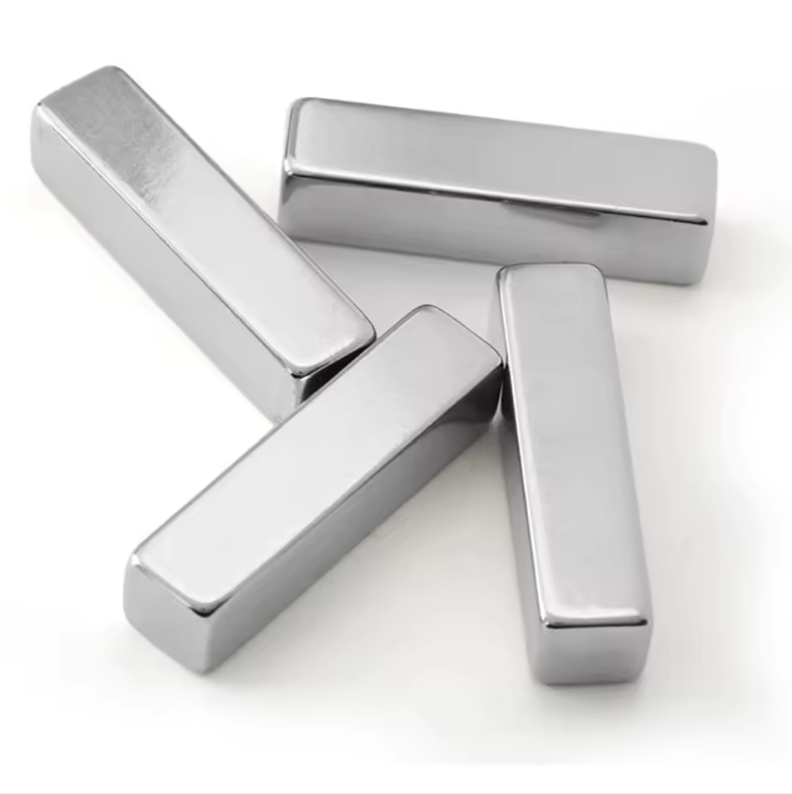
The geometry of a magnet does far more than just fill space inside a motor—it directly writes the shape of your torque curve. A simple rectangular block produces a fairly uniform magnetic field across its face, which translates into a torque curve that rises quickly and plateaus with predictable smoothness. But change that rectangle into a curved arc or a skewed trapezoid, and the field distribution shifts. The result is a torque curve that can be sculpted to favor low-end grunt, top-end pull, or a flatter mid-range response, all without touching the winding count or supply voltage.
Consider the air gap, where the real interaction happens. A magnet with a tapered thickness or a carefully chosen pole arc alters how the flux density varies across each electrical cycle. Instead of a near-square wave of torque, you can get a softer, more sinusoidal profile that reduces cogging and vibration. This is why many premium motors use bread-loaf or eccentric arc magnets—their shape isn't just for manufacturing convenience, it's a deliberate tuning tool. The torque curve becomes less about brute force and more about precision delivery, giving the rider or driver a smoother handshake with the throttle.
In practice, this means two motors with identical windings, identical diameters, and identical magnet volumes can feel completely different. A flat magnet with sharp corners might deliver a punchy, almost aggressive torque onset that suits stop-and-go riding. A curved magnet with rounded edges, on the other hand, spreads the same energy over a wider rotation angle, producing a progressive build-up that feels more controllable. The shape doesn't change how much torque you have—it changes when and how you get it, and that's a nuance only geometry can give you.
Reliable Suppliers for Consistent Magnetic Pull
Finding a supplier who can deliver the same pull force from one batch to the next is harder than it sounds. Many vendors list a maximum pull rating, but real-world performance drifts once production scales up. The most dependable ones test every coil or magnet assembly against a narrow tolerance band before shipping, and they are willing to share those test logs with you.
Look for suppliers who use calibrated pull-test fixtures rather than rough handheld gauges. A serious operation will keep reference samples from previous production runs and compare new output against them, adjusting magnetizing current or material grade as needed. Some will even offer to match the exact pull curve you've measured from a competitor's part, so you aren't locked into a single source.
The difference shows up on your assembly line. With a supplier that controls magnetic force tightly, you stop seeing random drops in holding strength or motors that draw slightly more current. Ask for a small trial batch and test twenty or thirty pieces yourself. If the numbers stay within a few percent of the target, you've probably found a partner worth keeping.
FAQ
Neodymium offers the highest magnetic output per unit volume, so you get serious torque without bulking up the rotor. The catch is heat—standard grades start losing strength around 80°C, so pick a high-temp variant like N42SH or N48H if the motor runs hot.
Samarium cobalt holds its field much better above 150°C and resists demagnetization, but costs more and is brittle. If your housing sees sustained heat beyond 120°C or you can’t afford a cooling redesign, samarium cobalt saves you from sudden torque loss mid-run.
Absolutely, especially for cost-sensitive or outdoor equipment. Ferrite is cheap, rust-resistant, and handles temperature swings without any protective coating. You sacrifice power density, but for brushed DC motors in pumps or fans, that trade-off often makes sense.
Nickel-copper-nickel is the standard and works fine indoors. For humid or salty environments, go with epoxy or PTFE coating—it seals edges and survives salt spray far longer. Avoid bare neodymium unless you want rust flakes inside the air gap.
Shape changes how flux distributes and where stress concentrates. Arc segments fit the rotor curve and reduce air gap, but sharp corners can chip during press-fitting. Chamfered edges or rounded trapezoids lower failure rates more than chasing a higher grade.
Ask for actual BH curves and pull-test data from the specific batch, not a generic catalog sheet. Request samples and check dimensions with a micrometer, then run a simple flux meter reading. Reputable suppliers will also list temperature coefficients for Br and Hcj—if those numbers are missing, walk away.
Keep them away from sharp impacts—neodymium chips easily, and samarium cobalt shatters. Store spare magnets in padded trays, not loose in a bin. During assembly, use non-magnetic tooling where possible, and never let stray metallic dust build up on the surface; it grinds into the coating over time.
Conclusion
Finding a motor magnet that holds up on the worst day means ignoring the marketing numbers and thinking about failure first. If your rotor sees sudden overloads, high ambient heat, or vibration, a generic N35 block won't save you—matching the magnet type to that worst-case scenario is the real starting point. Many engineers learn this the hard way after a motor loses torque mid-cycle because one letter in the grade was different. That letter is not a typo; it often indicates intrinsic coercivity and how far the material can be pushed before it starts to demagnetize irreversibly. What most datasheets don't show is the heat tolerance after prolonged exposure, not just the short-term maximum. The hidden figure is the knee point and how much flux comes back after cooling, which matters more than the headline temperature rating.
Coatings and corrosion get overlooked until rust creeps under the nickel and flakes the magnet apart, especially in humid or salt-heavy environments. The right epoxy or multi-layer coating can extend real lifespan by years, not months. Shape is another quiet performance lever: a simple flat magnet and a curved arc magnet with the same grade will produce different torque curves, cogging behavior, and air-gap flux density. If the shape doesn't match the back-iron and slot geometry, you get smooth specs on paper and rough performance in hand. Finally, consistent magnetic pull across a production run depends on more than a data sheet—it comes from suppliers who control particle size, sintering, and coating thickness batch after batch. That consistency is what separates a motor that feels strong in a prototype from one that stays strong in the field.
Contact Us
Contact Person: Kelvin Lo
Email: [email protected]
Tel/WhatsApp: 0769-88561131
Website: https://dawamagnetic.com/