

How Does a Pockels Cell Driver Improve Laser Switching Performance?
2026-09-29
Article Summary
A Pockels Cell Driver is a critical high-voltage control component used to operate electro-optic Pockels cells in advanced laser and photonics systems. By generating precise, fast-switching voltage pulses, it enables accurate control of laser polarization, pulse timing, beam modulation, and optical switching. This article explains how a Pockels Cell Driver works, why performance matching matters, common engineering challenges, and how Coupletech Co., Ltd. helps customers achieve stable and reliable electro-optic system integration.
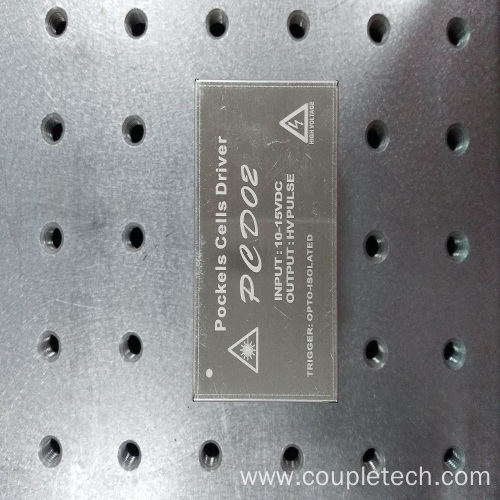
How Does a Pockels Cell Driver Work?
A Pockels Cell Driver is a specialized electronic device designed to provide high-voltage, high-speed electrical pulses for controlling a Pockels cell. A Pockels cell itself is an electro-optic component that changes the polarization state of light when an external electric field is applied to an electro-optic crystal. The driver provides the accurately timed voltage required to activate this optical switching process.
Unlike ordinary power supplies, a Pockels Cell Driver must achieve extremely fast voltage transitions and precise pulse control. In laser systems, even a small delay or unstable voltage output can influence pulse energy, beam quality, and overall system performance.
The working process generally includes three stages:
- Trigger Signal Input: The control system sends a timing signal according to the required laser operation sequence.
- High-Voltage Pulse Generation: The driver converts the input signal into a precisely controlled high-voltage output.
- Electro-Optic Switching: The applied voltage changes the crystal birefringence inside the Pockels cell, controlling the laser beam polarization.
Modern Pockels Cell Drivers are commonly used for applications such as Q-switching, pulse picking, cavity dumping, and regenerative amplification, where accurate optical timing is essential.
Why Is a Pockels Cell Driver Important in Laser Systems?
In precision laser applications, the Pockels cell determines whether optical switching can happen, but the driver determines how accurately and efficiently that switching occurs. A suitable driver directly affects laser stability, switching speed, and repeatability.
| Performance Requirement | Impact on Laser System |
|---|---|
| Fast Rise/Fall Time | Allows rapid optical switching and reduces timing errors. |
| Stable High Voltage Output | Maintains consistent polarization control and pulse quality. |
| Accurate Trigger Synchronization | Improves coordination between laser components. |
| Low Electrical Noise | Helps protect sensitive optical systems from interference. |
A poorly matched driver may cause issues such as incomplete switching, unstable pulse energy, optical losses, or reduced component lifetime. For this reason, selecting the driver according to the Pockels cell type, voltage requirement, repetition rate, and application environment is essential.
Key Performance Factors Engineers Need to Consider
When integrating a Pockels Cell Driver into an optical system, engineers usually focus on several technical parameters. Each factor influences the final system performance.
1. Output Voltage Range
Different electro-optic crystals require different operating voltages. The driver must provide sufficient voltage to reach the required switching condition without creating unnecessary electrical stress.
2. Pulse Width and Repetition Rate
High-speed laser systems often require drivers capable of generating short-duration pulses at high repetition frequencies. The pulse characteristics directly influence optical modulation accuracy.
| Parameter | Engineering Consideration |
|---|---|
| Pulse Width | Determines switching duration and laser timing control. |
| Repetition Frequency | Affects how frequently the optical switch can operate. |
| Rise Time | Defines switching speed and optical response. |
| Waveform Quality | Influences switching stability and system repeatability. |
3. Compatibility With Different Crystal Materials
Pockels cells may use different electro-optic crystals, including BBO, KD*P, KTP, and RTP. Each material has different electrical and optical characteristics, meaning the driver must be properly matched to achieve reliable operation.
Common Challenges in Pockels Cell Driver Applications
Engineers working with high-speed optical systems often encounter several practical challenges during development and integration.
Challenge 1: Unstable Optical Switching
If the voltage pulse is inconsistent, the Pockels cell may not switch completely, resulting in unstable laser output. High-quality drivers require accurate voltage control and reliable electronic design.
Challenge 2: Matching Driver and Pockels Cell Parameters
A driver that works well with one crystal type may not provide optimal performance for another. Engineers need to consider crystal material, capacitance, voltage level, and operating frequency together.
Challenge 3: Managing Heat and Long-Term Operation
Continuous high-frequency operation creates thermal challenges. Effective thermal design helps maintain stable electrical performance during extended operation.
Engineering Tip
Before selecting a Pockels Cell Driver, define your laser wavelength, crystal type, repetition rate, voltage requirement, and switching speed. A complete application analysis can prevent performance problems during system integration.
How to Select the Right Pockels Cell Driver?
Choosing the correct driver requires more than checking the output voltage. A complete evaluation should include electrical, optical, and mechanical requirements.
| Selection Factor | Questions to Evaluate |
|---|---|
| Pockels Cell Type | Is the driver compatible with BBO, KD*P, KTP, RTP, or other crystals? |
| Laser Application | Is it used for Q-switching, pulse picking, beam modulation, or amplification? |
| Operating Frequency | Does the driver support the required repetition rate? |
| Integration Method | Is a compact module or customized solution required? |
Professional manufacturers can provide customized solutions according to different laser architectures, helping customers reduce development time and improve system reliability.
Applications of Pockels Cell Drivers
Due to their fast switching capability and precise voltage control, Pockels Cell Drivers are widely used in advanced photonics systems.
- Laser Q-Switching: Controls laser cavity losses to generate high-energy pulses.
- Pulse Picking: Selects specific pulses from high-frequency laser sources.
- Cavity Dumping: Enables controlled extraction of laser energy.
- Scientific Research: Supports precision optical experiments and measurement systems.
- Industrial Laser Processing: Improves control accuracy in cutting, marking, and micro-processing systems.
Why Choose Coupletech Co., Ltd.?
Coupletech Co., Ltd. focuses on advanced electro-optic components and laser control technologies, providing reliable solutions for customers in scientific research, industrial laser systems, and optical equipment integration.
With professional experience in photonics engineering, Coupletech Co., Ltd. understands that every laser system has different requirements. From product selection to technical communication, the company supports customers in achieving stable and efficient optical performance.
- Professional knowledge in electro-optic and laser control technologies
- Solutions designed for different application requirements
- Support for customized optical system integration
- Focus on stable performance and long-term reliability
Frequently Asked Questions
Q1: What is a Pockels Cell Driver used for?
A Pockels Cell Driver generates high-voltage electrical pulses to control Pockels cells in laser and electro-optic systems. It is commonly used for Q-switching, pulse picking, cavity dumping, and optical modulation.
Q2: Why does a Pockels Cell require a high-voltage driver?
The electro-optic crystal inside a Pockels cell changes its optical properties under an electric field. The driver provides the required voltage with accurate timing to achieve fast optical switching.
Q3: Can one Pockels Cell Driver work with all Pockels cells?
Not necessarily. Different crystals and applications require different voltage levels, pulse characteristics, and operating conditions.
Q4: What information should customers provide before purchasing?
Customers should provide details including crystal type, wavelength, repetition rate, voltage requirement, pulse width, and application purpose.
Q5: Does Coupletech Co., Ltd. provide customized Pockels Cell Driver solutions?
Yes. Coupletech Co., Ltd. can communicate with customers according to specific laser system requirements and provide suitable electro-optic solutions.
Contact Us for Your Pockels Cell Driver Solution
Selecting the right Pockels Cell Driver is essential for achieving precise laser control and stable optical performance. Whether you are developing a new photonics system or upgrading an existing laser platform, Coupletech Co., Ltd. can provide professional technical support and reliable solutions.
Contact us today to discuss your application requirements and find the right Pockels Cell Driver solution for your project.